
Did you know that nearly 70% of wine enthusiasts inadvertently damage their bottles due to improper storage?
Whether you’ve just received a special bottle as a gift or you’re beginning to build your collection, knowing how to preserve wine properly is essential to maintaining its character and complexity. The art of wine preservation isn’t just for sommeliers and collectors – it’s a valuable skill for anyone who appreciates a good glass of wine!
I’ve been preserving wines for over two decades, and I’m excited to share the fundamentals to help you start your wine preservation journey on the right foot. From understanding temperature requirements to selecting the right storage solutions, this guide will walk you through everything you need to know to keep your wines in peak condition.
Welcome to Didi Somm, and Cheers!
Important Notice: The information in this article is for general and public information purposes only. It solely reflects Didi Somm’s or his Staff’s opinion, and no responsibility can be assumed for errors or omissions in the service’s contents. For details, please check the Disclaimer at the bottom of the homepage.
Key Takeaways
- Consistent temperature between 45-65°F (7-18°C) is critical for proper wine preservation
- Humidity levels should be maintained at 60-70% to keep corks from drying out
- Light exposure, especially UV rays, can damage wine and cause premature aging
- Different wines have different preservation requirements and lifespans
- Basic preservation tools like wine stoppers and vacuum pumps are affordable starting points
- Proper storage position (horizontal for corked wines) helps maintain quality
- Wine refrigerators offer an excellent entry-level solution for serious beginners
Understanding Wine Preservation Basics
Let me tell you something I learned the hard way – wine is alive in that bottle!
I still remember opening a beautiful Cabernet I’d been “saving,” only to discover it had turned to vinegar on my kitchen counter. Proper preservation isn’t wine snobbery – it’s about keeping those natural processes moving in the right direction.
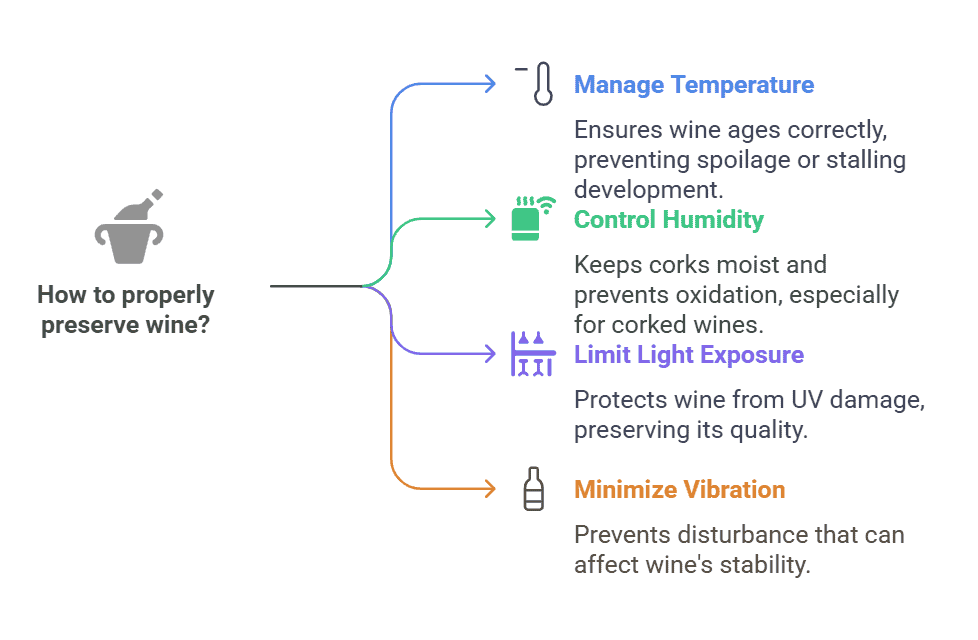
Wine preservation comes down to four critical factors: temperature, humidity, light, and vibration. Think of these as the “four horsemen” of wine apocalypse! Temperature ranks as most important – too warm and your wine ages too quickly, too cold and development stalls. After ruining several bottles, I invested in a simple thermometer and was shocked to discover my “cool” closet hit 75°F in summer.
The cork versus screw cap debate isn’t just about quality. Corked wines need more careful preservation because the cork must stay moist (that’s why humidity matters). Screw caps provide a tighter seal but remain sensitive to temperature and light.
Oxygen transforms wine in fascinating ways. A little exposure (like when decanting) develops flavors, but too much creates vinegar. This explains why wine can taste perfect after opening but terrible the next day. A vacuum pump for opened bottles has been a game-changer for enjoying the same bottle over several days.
The biggest misconception? That all wines improve with age. About 90% of wines should be consumed within five years of production. I wasted time and money “aging” wines already past their prime. Learning which wines benefit from aging (those with high tannins, acidity, or sugar) has saved me countless disappointments.
Affiliate Disclaimer: This page may include Affiliate links, meaning that we get a commission if you decide to purchase through this site at no extra cost to you. Please read our Disclaimer for your info.
Essential Equipment for Beginner Wine Preservation
When I first got serious about wine preservation, I went overboard with gadgets. Big mistake!
You need surprisingly little to start preserving wine properly. The essentials: good wine stoppers for recorking opened bottles, a vacuum pump system to remove oxygen, and possibly inert gas spray for special bottles. I started with just stoppers and a vacuum pump for about $30 total, which served me well for years.
Budget matters when you’re starting. Those $200+ Coravin systems looked impressive but unnecessary for my needs. For most casual wine drinkers, a $15 vacuum pump works perfectly fine. I still use the Vacu Vin pump I bought eight years ago! For special bottles you only want a glass from, argon gas spray preservers ($10-15) work beautifully for short-term preservation by creating a protective layer between wine and oxygen.
Not all preservation tools perform equally. Those cheap plastic stoppers from grocery stores are nearly useless – they pop out easily and don’t seal well. Silicone stoppers with tight fits prove much more effective. For vacuum pumps, listen for that satisfying “thunk” indicating a proper seal. If it’s too easy to pump, it’s probably not working right.
After experimentation, I’ve identified the true essentials: quality stoppers, a vacuum pump, and a good thermometer for your storage area. Nice-to-haves include inert gas spray, specialized champagne stoppers, and electronic preservers. I wish someone had explained this before I wasted money on rarely used gadgets!
To spot quality preservation tools without overspending, check for weight and thickness in stoppers, ensure vacuum pumps create strong resistance, and read reviews from people who’ve used them for months, not just received them.

Setting Up Your First Wine Storage Space
Creating my first wine storage space was a journey of trial and error. I started storing bottles in various spots before realizing consistency matters most. My first real solution? A repurposed coat closet in the hallway – naturally cooler than the rest of the house and windowless. Nothing fancy – just basic wine racks and a $10 thermometer/hygrometer to monitor conditions. You don’t need a custom cellar to preserve wine properly!
Finding the right location requires detective work. I spent a week measuring temperatures before choosing that hallway closet. Look for spaces maintaining consistent temperatures around 55°F (13°C) and avoid areas near heating vents, appliances, or windows. The kitchen is usually terrible for wine storage – something I learned after ruining good bottles! Basements work well if not too damp, and north-facing closets often maintain stable temperatures.
Wine Storage Location Decision Tree

DIY environmental control can be surprisingly effective. I placed a shallow water pan in my storage closet to increase humidity (cork-sealed wines need humidity to prevent corks from drying). During summer heat, I’ve used everything from rotating frozen water bottles to small fans circulating air from cooler areas. These aren’t perfect solutions but work well enough while saving for proper equipment.
Your first wine rack doesn’t need to be complicated. I started with a simple 12-bottle wooden rack for about $30. What matters most? Stability and proper horizontal positioning for corked wines. Wood or metal works fine – just avoid plastic racks that can bend under bottle weight. I prefer designs that hold bottles horizontally with labels visible for easy identification.
Pro Tip: To get an overview on the types of wine racks in the market, I highly recommend checking the website of Wine Racks America.
Limited space presents challenges in apartments. My solution? Going vertical with wall-mounted racks and utilizing awkward spaces like areas under stairs or beside furniture. Just measure temperatures before committing – they can vary dramatically even within a few feet!
Temperature Management: The Most Critical Factor
Temperature management is the game-changer for wine preservation. After losing several bottles to heat damage (that unmistakable cooked fruit flavor – yuck!), I learned different wines have specific temperature requirements. Red wines generally prefer 55-65°F (13-18°C), while whites do better slightly cooler at 45-55°F (7-13°C). I keep my storage around 55°F as a good compromise, then adjust before serving. Surprisingly, it’s better to store wine slightly too cool than too warm – heat is wine’s number one enemy!
Temperature fluctuations cause insidious damage. I once stored nice Bordeaux in what I thought was a “stable” closet, only to discover daily fluctuations of 5-10 degrees were silently ruining them. These changes cause wine to expand and contract, pressuring the cork and potentially allowing oxygen seepage. My revelation came after placing a digital thermometer with memory function in my storage area – those overnight drops and daytime spikes were far more dramatic than I’d realized!
Monitoring temperature needn’t be expensive. I started with a $15 digital thermometer/hygrometer combo tracking min/max temperatures – absolute game-changer! Later I upgraded to a Bluetooth sensor alerting my phone when temperatures exceed my set range, saving bottles during summer power outages. Even without technology, checking a simple thermometer at different times for a week reveals whether your space maintains stable temperatures.
I’ve learned about dangerous storage locations through painful experience. The kitchen rack above my refrigerator? Disaster – heat from the fridge coils cooked my wines in weeks! The garage seemed convenient until summer turned it into a wine sauna. Even that stylish rack in my sunny dining room proved problematic due to afternoon sun. Interior closets, basements, and north-facing rooms with minimal sun exposure typically offer the most stable environments.
Seasonal adjustments became necessary once I understood temperature’s importance. During summer heatwaves, I temporarily move my collection to the basement or use coolers with ice packs for short-term heat emergencies. In winter, I watch for locations near heating sources. These seasonal checks seemed excessive initially, but after saving valuable bottles from temperature spikes, they’re absolutely worth the effort.

Humidity and Light Control for Wine Longevity
Humidity control was something I completely overlooked when starting out. Big mistake! I discovered its importance after finding prized bottles with dried, crumbly corks that had begun shrinking and letting air in. The sweet spot for wine storage humidity is 60-70%. Too low (under 50%), and corks dry out and shrink, allowing oxygen to seep in. Too high (above 80%), and you risk mold growing on labels and corks. Humidity is the unsung hero of proper wine storage – nearly as important as temperature for long-term preservation.
Simple methods can effectively adjust humidity in storage areas. When my space was too dry (common in winter with heating running), I placed a small water pan near the wine rack, which gradually evaporated and raised humidity. For consistently dry areas, I’ve used damp towels draped over hangers or cigar humidifiers. When facing high humidity (like in summer basements), a small container of silica gel or rice helped absorb excess moisture. Dehumidifiers work too, but beware – they generate heat in confined spaces!
Light damage became apparent after noticing differences between bottles stored at the front versus back of my rack. Light – especially UV – is surprisingly destructive to wine, triggering reactions that create off-flavors and premature aging. There’s a reason quality wine comes in colored glass! My window-adjacent wine rack produced noticeably flatter flavors and less vibrancy within months. Natural light causes the most damage, but fluorescent lighting can harm wine over time too.
For light control, I installed blackout curtains for windows near my storage – not just room curtains, but a separate cover specifically for the storage area. UV-filtering window film works well if you can’t avoid bright locations. Even covering racks with dark cloth helps. For long-term storage bottles, I keep them in original boxes or use wine sleeves for extra light protection.
Monitoring humidity doesn’t require expensive equipment. I started with a basic $10 hygrometer from a home improvement store – the same kind used for greenhouses. Now I use a combination temperature/humidity monitor with Bluetooth capability ($35) that alerts my phone if conditions fall outside parameters. Even color-changing humidity indicator cards (about $5) can provide basic guidance if your storage area is too dry or humid.
Wine Refrigerators: Worth the Investment?
My wine preservation journey transformed when I finally purchased my first wine refrigerator. After years of makeshift storage solutions and temperature battles, that wine fridge was revelatory! Unlike regular refrigerators (too cold at 35-40°F and lacking humidity control), wine refrigerators maintain ideal conditions between 45-65°F with humidity around 50-70%. My regular fridge was actually ruining wines by keeping them too cold and dry – something I discovered after a beautiful Chardonnay turned flat and lifeless.
The cost-benefit analysis initially gave me pause. Entry-level models start around $150-300 for 18-30 bottles, which seemed steep for my modest collection. But after calculating the value of wines I’d ruined through improper storage (easily $200+), the math made sense. I started with a basic 16-bottle thermoelectric model for about $180 – one of my best wine investments. For beginners with even 5-10 decent bottles they want to preserve properly, the investment makes sense if you plan to continue exploring wines.
When shopping for wine refrigerators, focus on what truly matters: temperature stability (look for reviews mentioning minimal fluctuations), low vibration (especially important for aging wines with sediment), UV-protected glass doors (or solid doors for better insulation), and humidity control. Features I rarely use despite initial excitement? Fancy digital displays and temperature alarms. Worth splurging on? Adjustable wooden shelves rather than fixed metal ones – they’re gentler on bottles and accommodate different shapes.
Maintenance considerations surprised me. My first unit needed regular defrosting and eventually developed condensation issues. Better models have auto-defrost functions, which I highly recommend. Energy consumption varies – my current compressor unit adds about $2-4 monthly to my electric bill, reasonable for protecting my wine investment. Most important maintenance tip? Keep coils dust-free and ensure proper ventilation around the unit. My first fridge died prematurely because I had it wedged too tightly in a cabinet.
For beginners, the single-zone versus dual-zone decision is simpler than it seems. While dual-zone refrigerators let you store different wines at different temperatures, a quality single-zone unit set around 55°F works perfectly fine for storage. Simply adjust serving temperatures before drinking. I started with single-zone and didn’t miss having dual zones until my collection grew significantly. The money saved by choosing single-zone often gets you higher quality with better temperature stability – ultimately more important than multiple temperature zones.
Organizing Your Wine Collection
Organization became essential once my collection grew beyond a few bottles. I learned this after losing track of a special anniversary bottle that got pushed to the back of my storage. By the time I found it years later, it was well past its prime!
Simple Tracking System
Now I use a simple tracking system recording each bottle’s details (producer, region, vintage, purchase date, and drinking window) along with storage location. This might seem excessive for beginners, but even small collections benefit from basic organization – it prevents forgotten bottles and helps you enjoy each wine at its best.
Digital Versus Analog Tracking
Digital versus analog tracking comes down to preference. I started with a simple spreadsheet that worked great until my collection reached about 50 bottles. Wine apps like Vivino or CellarTracker offer conveniences including label scanning and drinking window predictions. For analog preferences, wine journals or index cards work well for smaller collections. My hybrid approach uses digital inventory for tracking combined with colored stickers on bottles indicating drinking windows – green for “drink now,” yellow for “wait a bit,” and red for “long-term aging.” This visual system helps me quickly choose bottles without consulting my full inventory.
Physical Arrangement
Physical arrangement affects both preservation and accessibility. I organize by drinking windows rather than strict categorization by region or type. Wines for immediate consumption stay in easily accessible spots, while age-worthy bottles rest undisturbed in harder-to-reach areas. One practical tip: store similar wines together to avoid searching your entire collection when you want “that Italian red.” For positioning, keep corked wines horizontal to maintain moist corks, while screw-capped wines can be stored upright if space requires.
Labeling
As collections grow, labeling becomes increasingly important. Besides my colored sticker system, I’ve created simple section dividers in my wine fridge using cardstock labels. These separate my collection into categories like “everyday reds,” “special occasion whites,” and “aging potential.” Some collectors use elaborate neck tags with detailed information, but simpler systems usually work better for beginners. Create a system that makes sense to you and helps you enjoy the right wine at the right time.
Proper Bottle Handling
Proper bottle handling prevents unnecessary disturbances. Every movement potentially disrupts sediment and aging, especially for older wines. I now handle bottles as little as possible, particularly those aging long-term. When reorganization becomes necessary, I do it quickly and gently. Practical tip: keep “drink soon” bottles on middle shelves at eye level for easy access, while aging wines go on lower shelves where they’ll remain undisturbed. This arrangement naturally minimizes movement of precious bottles.
Preservation Timelines for Different Wine Types
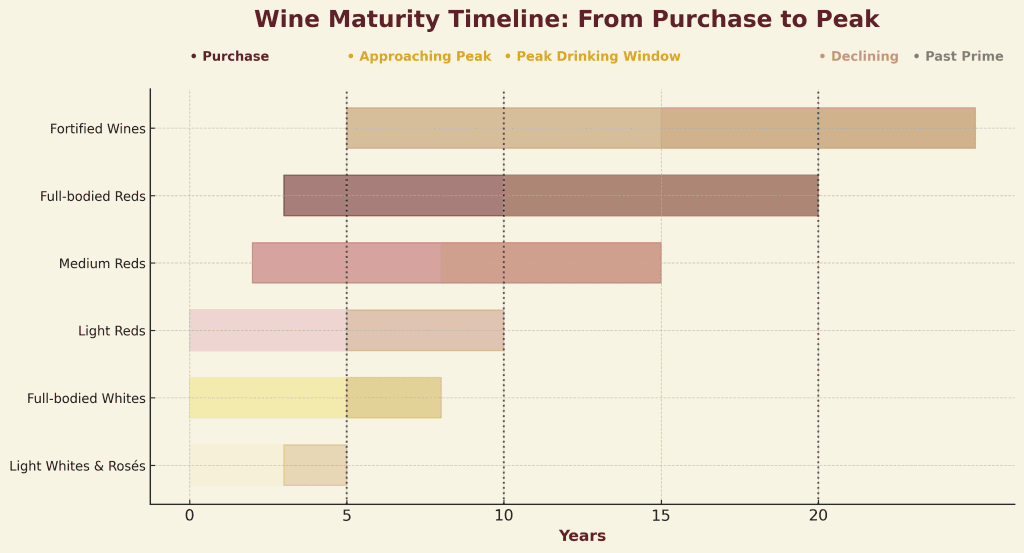
Understanding wine preservation timelines revolutionized my collection approach. I once thought all wines improved with age – completely wrong! After waiting five years to open a lovely New Zealand Sauvignon Blanc only to find it had lost all its vibrant fruit character, I learned my lesson. Most white wines should be consumed within 1-3 years of their vintage date, with exceptions like certain Chardonnays, Rieslings, and Chenin Blancs that develop beautifully over 5-10+ years. Reds vary tremendously – lighter styles like Beaujolais or Pinot Noir often peak within 3-5 years, while tannic Cabernets, Syrahs, and Bordeaux blends might need 10+ years to reach their prime. These timelines have saved me countless disappointments!
Identifying age-worthy wines requires attention to key indicators. Wines with good aging potential typically have higher acidity, tannin (for reds), or sugar content – natural preservatives that support longevity. Wine shop staff can often provide guidance, but price offers useful clues – wines under $15 usually target early consumption, while those above $30 more commonly have aging potential. Structure matters more than flavor intensity – I’ve had delicate wines that aged beautifully due to excellent structural balance. Resource books like Hugh Johnson’s Pocket Wine Book offer vintage-specific aging recommendations that have proven invaluable for collection planning.
Recognizing a wine at its peak takes practice. Look for harmony between fruit, acidity, tannin (for reds), and secondary flavors that develop with age. For reds, tannins soften and integrate, while whites develop deeper, sometimes honeyed characteristics. The clearest sign is complexity – aromas and flavors that unfold in layers rather than all at once. I’ve learned to open special bottles when approaching their estimated peak rather than waiting for specific occasions. It’s better to drink a wine a year too early than a day too late!
Improperly stored wine shows telltale signs: cork pushing up from the bottle (heat damage), wine seeping around the cork, unusual colors (brownish whites or brick-orange reds when they should appear more vibrant), and off aromas like vinegar, wet cardboard, or nail polish remover. When evaluating bottles, examine fill levels (lower levels suggest evaporation through compromised corks) and check for leakage signs before purchasing.
Different wine types have vastly different preservation expectations. Most commercial rosés and light, unoaked whites peak within 1-2 years of release. Fuller-bodied whites (especially oak-aged) can improve for 2-5 years. Light reds last 2-5 years, while medium-bodied reds with good structure might develop for 5-10 years. Only big, tannic reds and fortified wines like Port have genuine long-term aging potential of 10-20+ years. Remember: even the most age-worthy wine won’t last in poor storage conditions!
Opened Bottle Preservation Techniques
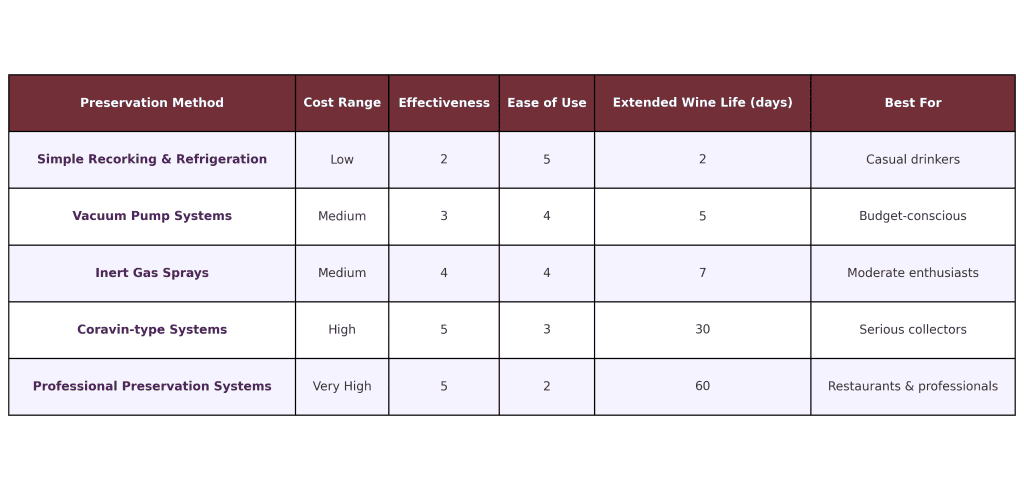
Preserving opened wine bottles became a priority after pouring too many half-bottles down the drain. Three methods have proven consistently effective in my experience. The simplest approach: recorking and refrigerating – yes, even red wines! Cool temperatures dramatically slow oxidation. Vacuum pumps physically remove air from the bottle, extending life by several days. For special bottles, inert gas preservation (like Private Preserve spray) creates a protective blanket of argon or nitrogen over the wine surface. For premium wines, I occasionally use a Coravin system, which extracts wine through the cork without introducing oxygen – perfect for sampling special bottles over months!
The lifespan of opened wines varies dramatically by style. Light whites and rosés typically last 3-5 days with proper refrigeration and resealing. Fuller-bodied whites maintain quality for 5-7 days. Light reds like Pinot Noir stay fresh for 3-4 days, while tannic reds can sometimes improve on day two and remain drinkable for 5-7 days. The biggest preservation surprises were fortified wines like Port and Madeira, which can last weeks or even months after opening due to higher alcohol and sugar content. Sparkling wines present the greatest challenge – even with specialized stoppers, they rarely maintain good bubbles beyond 1-2 days.
My comparative tests of preservation methods revealed surprising results – some popular techniques barely outperformed simple recorking! Refrigeration alone extended most wines’ life by 1-3 days compared to room temperature storage. Vacuum pumps added another 1-2 days of freshness, though they sometimes remove aromatic compounds along with air. Inert gas sprays performed best, often keeping wines drinking well for twice as long as recorking. Results vary by wine style – delicate aromatics in wines like Riesling or Gewürztraminer are more easily lost with vacuum pumps, while tannic reds seem less affected. Match your preservation method to both wine style and needed timeframe.
Detecting when opened wine is past its prime follows a predictable progression: first, fresh fruit aromas diminish, then oxidative notes of bruised apple, nuts, or sherry emerge (especially in whites). Colors change too – whites darken to amber while reds lose vibrant purple or ruby edges and turn brownish. On the palate, vibrant fruit flavors flatten, acidity seems more pronounced as fruit fades, and eventually, vinegar notes develop. Trust your nose – if wine smells significantly different from when opened, especially with nutty or vinegar notes, it’s usually past its drinking prime.
Don’t waste wines no longer good for drinking – they can shine in the kitchen! Slightly oxidized wines make excellent cooking ingredients – I freeze them in ice cube trays for easy portions. Reds past their drinking prime work perfectly for deglazing pans or meat sauce reductions. Whites enhance risottos and cream sauces. Wines starting to turn can complete the transformation into homemade wine vinegar by adding the mother of vinegar. Sweet wines can be reduced to syrup for desserts.
The only opened wines I discard show signs of microbial spoilage with mousy or sewage-like aromas – those are unfortunately beyond salvation!
Scaling Up: Moving Beyond Beginner Preservation
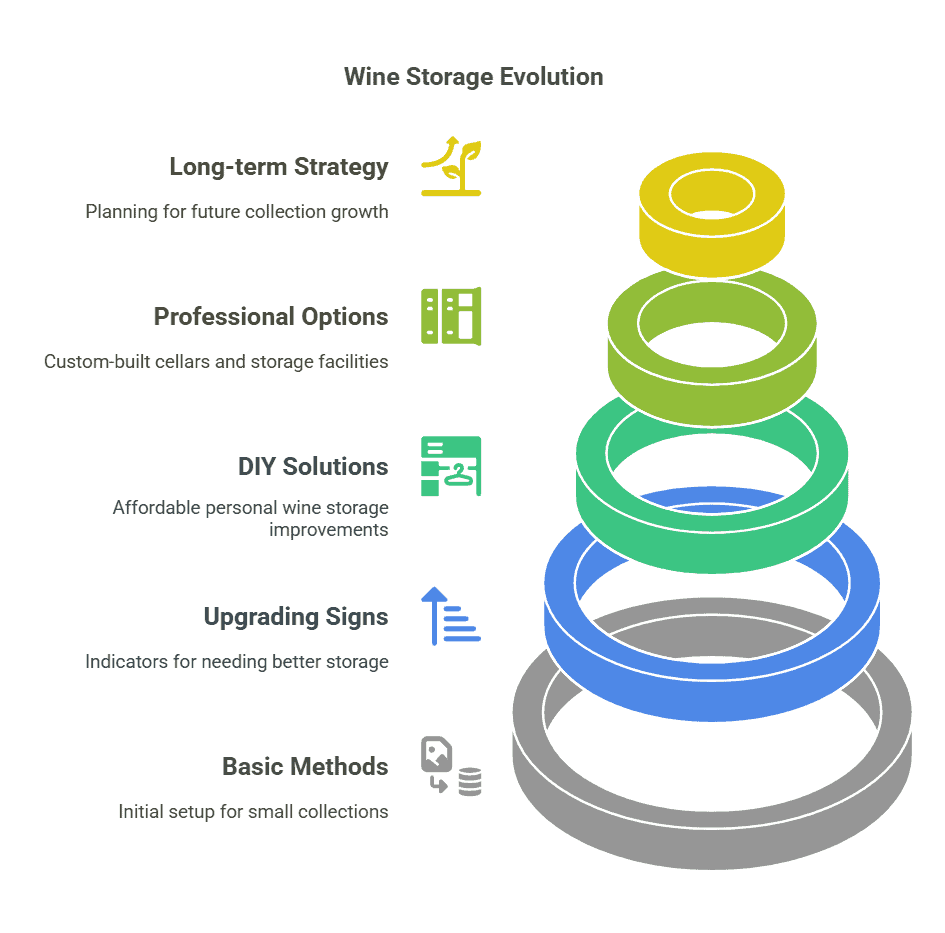
My progression beyond beginner wine preservation happened gradually as my collection grew from a dozen bottles to over a hundred. I recognized I’d outgrown my initial setup when temperature fluctuations in my wine refrigerator became more frequent and I constantly rearranged bottles to accommodate new purchases. Clear signs you’re ready to upgrade: running out of proper storage space, acquiring wines meant for longer aging, or feeling frustrated by current system limitations.
My tipping point came when overflow bottles ended up in less-than-ideal conditions because my wine fridge was full – that’s when I knew scaling up had become necessary.
DIY Solutions
Exploring wine cellar options opened exciting possibilities. I converted a small closet into a dedicated wine room with insulation, cooling unit, and proper racking – a $1,500 DIY project that dramatically improved storage capacity and conditions. For those with more space and budget, built-in cellars offer ultimate controlled preservation, typically starting at $5,000-10,000 for professional installation. Key requirements remain consistent regardless of size: stable temperature (ideally 55°F/13°C), appropriate humidity (60-70%), darkness, minimal vibration, and good organization.
Even without dedicated rooms, larger capacity wine refrigerators (100+ bottles) offer excellent preservation while occupying less space than full cellars.
Scaling Up
Financial considerations deserve careful analysis when scaling up. I think of proper wine storage as insurance for my growing collection. With a collection worth several thousand dollars, investing in proper storage equipment represents a reasonable percentage of that value. My rule of thumb: if your collection is worth less than $1,000, stick with entry-level preservation methods. Between $1,000-5,000, consider quality wine refrigerators. Above $5,000 (especially with age-worthy wines), more comprehensive solutions like converted closets or small cellars make financial sense.
The critical question: how long will you store wines? Proper storage becomes essential rather than optional for bottles meant to age 10+ years.
Professional Storage Facilities
Professional storage facilities entered my strategy once my collection included investment-grade bottles. Many urban areas offer temperature-controlled wine lockers or custom storage for monthly fees ($15-50 depending on capacity). These services particularly benefit apartment dwellers or those in extreme climate regions. I currently use a hybrid approach – keeping wines I’ll drink within a year or two at home in my wine refrigerator, while storing more valuable, age-worthy bottles in a professional facility.
This provides everyday wine accessibility while ensuring optimal conditions for special bottles meant for long-term aging.
Long-Term Preservation Strategy
Long-term preservation strategy develops alongside wine knowledge. Successful collecting requires thinking years ahead – considering not just current storage needs but future growth. For those moving beyond beginner status, create a plan addressing your specific collecting habits. Are you acquiring mostly drink-now wines with a few special bottles, or building a serious age-worthy collection? Do you prefer everything accessible, or are you comfortable with off-site storage? Documentation becomes increasingly important – I now maintain detailed records of purchase dates, optimal drinking windows, and storage locations.
The most valuable lesson? Be realistic about consumption rates and collect accordingly – proper preservation means nothing if you miss drinking windows of carefully stored wines!
FAQ – How To Preserve Wine
1. How long can I store wine at room temperature?
Most wines are best not stored at room temperature for more than a few weeks. Room temperature is typically around 70°F (21°C), which is warmer than ideal for wine preservation. Extended storage at this temperature can speed up aging and potentially damage the wine.
2. Do all wines improve with age?
No, contrary to popular belief, approximately 90% of wines produced worldwide are intended to be consumed within 1-5 years of their vintage date. Only certain wines with the right structure, acidity, tannins, and sugar levels benefit from extended aging.
3. What’s the best way to store opened sparkling wine?
For opened sparkling wine, use a specialized sparkling wine stopper that clamps onto the bottle to maintain pressure. Store the bottle upright in the refrigerator, where it can typically stay fresh for 1-3 days, though it will gradually lose carbonation.
4. Can I store wine in my regular kitchen refrigerator?
Regular refrigerators are not ideal for wine storage beyond a few days to weeks. They’re typically too cold (around 35-38°F/1-3°C), have low humidity that can dry out corks, and experience vibrations from the compressor that can disturb wine sediment.
5. Should I store my wine bottles horizontally or vertically?
Corked wines should be stored horizontally to keep the cork moist and expanded, preventing air from entering the bottle. Screw-cap wines and bottles intended for short-term storage (less than a month) can be stored vertically without issue.
6. What’s the minimum I need to spend on wine preservation equipment?
You can start preserving wine properly with as little as $20-30, which would cover basic wine stoppers and possibly a vacuum pump. However, for more serious preservation, budget at least $100-200 for a small wine refrigerator or a quality storage rack and some preservation tools.
7. How can I tell if my wine has gone bad from improper storage?
Signs of wine that has been improperly stored include cork pushing up from the bottle, wine leaking around the cork, unusual color (brownish for white wines or brick-orange for reds), and off aromas like vinegar, wet cardboard, or nail polish remover when opened.
8. Is it worth buying a vacuum pump wine preserver?
Vacuum pumps are reasonably effective and affordable for beginners. They remove some oxygen from opened bottles, extending the wine’s life by 3-7 days. While not perfect (they can remove some volatile compounds), they offer good value for casual wine drinkers.
9. What’s the ideal humidity for wine storage?
The ideal humidity for wine storage is between 60-70%. This level is high enough to keep corks from drying out and shrinking (which would allow air into the bottle) but low enough to prevent mold growth and label damage.
10. Can I store different types of wine together?
Yes, you can store different types of wine together as long as all are kept at appropriate conditions. If using a single-zone wine refrigerator, set it around 55°F (13°C) as a good compromise for both red and white wines. For serving, adjust the temperature appropriately before opening.
11. How do temperature fluctuations affect wine?
Temperature fluctuations are particularly damaging to wine because they cause the liquid to expand and contract, potentially pushing against the cork or creating pressure changes in the bottle. This can lead to premature aging, oxidation, and flavor deterioration.
12. What’s the difference between wine preservation and wine aging?
Wine preservation focuses on maintaining a wine’s current quality by providing optimal storage conditions, while wine aging is the intentional storage of age-worthy wines to develop more complex flavors over time. All wines require proper preservation, but not all wines benefit from aging.
13. Can I use my basement for wine storage?
Basements can be excellent for wine storage if they maintain a consistent temperature between 45-65°F (7-18°C) with moderate humidity and minimal light. However, many modern basements have heating systems, dehumidifiers, or temperature fluctuations that make them unsuitable without modifications.
14. How much does vibration really affect wine?
Vibration can negatively impact wine by disturbing sediment, accelerating chemical reactions, and potentially agitating the liquid enough to speed up aging. For short-term storage (under a year), minor vibrations are less concerning, but for aging fine wines, a vibration-free environment is important.
15. Can I freeze wine for preservation?
Freezing wine is not recommended for quality preservation. While it can be done in a pinch for cooking wine, freezing changes the wine’s structure and flavor compounds. Additionally, as wine freezes, it expands and can push out the cork or even break the bottle.
Conclusion
Embarking on your wine preservation journey doesn’t have to be complicated or expensive.
By understanding the fundamental factors that affect wine quality – temperature, humidity, light, and vibration – you can make informed decisions about how to store your bottles properly. Start small with basic preservation tools like quality wine stoppers and perhaps a dedicated storage area in a cool, dark part of your home.
As your collection and knowledge grow, you can invest in more sophisticated solutions like wine refrigerators or even custom cellars. Remember that proper preservation is about enjoying each bottle at its best, whether that’s a Tuesday night table wine or a special vintage you’re saving for a celebration.
With the techniques outlined in this guide, you’re well-equipped to confidently begin preserving your wines.
Cheers to your newfound knowledge and the many perfectly preserved bottles in your future!
For your reference, the latest articles by Didi Somm include:
- Top 3 Thermoelectric Wine Coolers – Best Expert Guide For You
- Wine Fridge Humidity Control: Get Insights And Best Advice
- How To Upgrade Wine Fridge: Best Expert Guide For You
- Wine Refrigerator Accessories 2025: The Ultimate Guide For You
- Under-Counter Wine Refrigerators In 2025: Best Advice For You
- Best Wine Fridge Brands – The Ultimate Comparison For 2025
Important Notice: The information in this article is for general and public information purposes only. It solely reflects Didi Somm’s or his Staff’s opinion, and no responsibility can be assumed for errors or omissions in the service’s contents. For details, please check the Disclaimer at the bottom of the homepage.


