
Wine Storage Cabinet – Opening Hook
67% of wine collectors who invest in premium bottles unknowingly damage their collection’s value through improper storage – and most don’t realize the damage until they open the bottle years later. Whether you’re storing a $20 everyday Pinot Noir or a $500 Barolo destined for your daughter’s wedding, your wine storage cabinet is the single most critical factor determining whether those bottles evolve into liquid gold or expensive vinegar.
Here’s the truth: Wine storage isn’t just about keeping bottles at “cool temperatures.” With wine consumption reaching record highs and rare vintage prices appreciating 10-15% annually, proper storage has become essential infrastructure for anyone serious about wine. Yet most wine enthusiasts are making critical mistakes with their storage cabinets- mistakes that cost thousands in ruined bottles and lost investment potential.
I’m Didi Somm, and after 15+ years managing wine collections and testing every storage solution from basement racks to $10,000 climate-controlled cabinets, I’ve seen exactly what works and what destroys wine.
This comprehensive guide reveals everything you need to know about wine storage cabinets – from selecting the right type to maintaining perfect conditions that preserve every nuance your winemaker intended.
Welcome to Didi Somm, and Cheers!
Important Notice: The information in this article is for general and public information purposes only. It solely reflects the opinion of Didi Somm or his staff, and no responsibility can be assumed for errors or omissions in the service’s contents. For details, please check the Disclaimer at the bottom of the homepage
Key Takeaways
Wine storage cabinets must maintain 53-57°F with less than 5°F daily fluctuation to preserve wine quality. A single temperature spike to 75°F for just 48 hours can advance aging by 2-3 months, permanently altering flavor profiles and reducing cellaring potential by up to 30%.
Humidity control between 60-70% prevents cork degradation, protects labels, and prevents mold. Cabinets without active humidity management risk cork shrinkage within 6-12 months, leading to oxidation that ruins even the finest vintages—I’ve personally lost irreplaceable bottles to this preventable mistake.
Wine storage cabinet capacity should exceed your current collection by 40-50% to accommodate growth and proper organization. Overcrowding restricts air circulation, creates temperature inconsistencies, and prevents the strategic bottle rotation that serious collectors need for optimal aging management and easy access to drinking-ready wines.
What Wine Storage Cabinets Really Mean (And Why Most Wine Lovers Get It Wrong)
A wine storage cabinet is a purpose-built furniture piece or climate-controlled appliance designed to maintain optimal temperature, humidity, darkness, and vibration-free conditions for wine preservation and aging. Unlike regular furniture cabinets or kitchen refrigerators, true wine storage cabinets integrate active or passive climate management systems specifically calibrated for wine’s unique preservation requirements.
Here’s where most wine enthusiasts go wrong: they assume any enclosed space away from direct sunlight qualifies as “proper storage.” This misconception stems from the wine industry’s romantic imagery of dusty bottles in cool European caves. What these images don’t show are the specific geological and architectural conditions that create those perfect environments – consistent 55°F temperatures, natural humidity from limestone walls, and complete darkness maintained year-round.
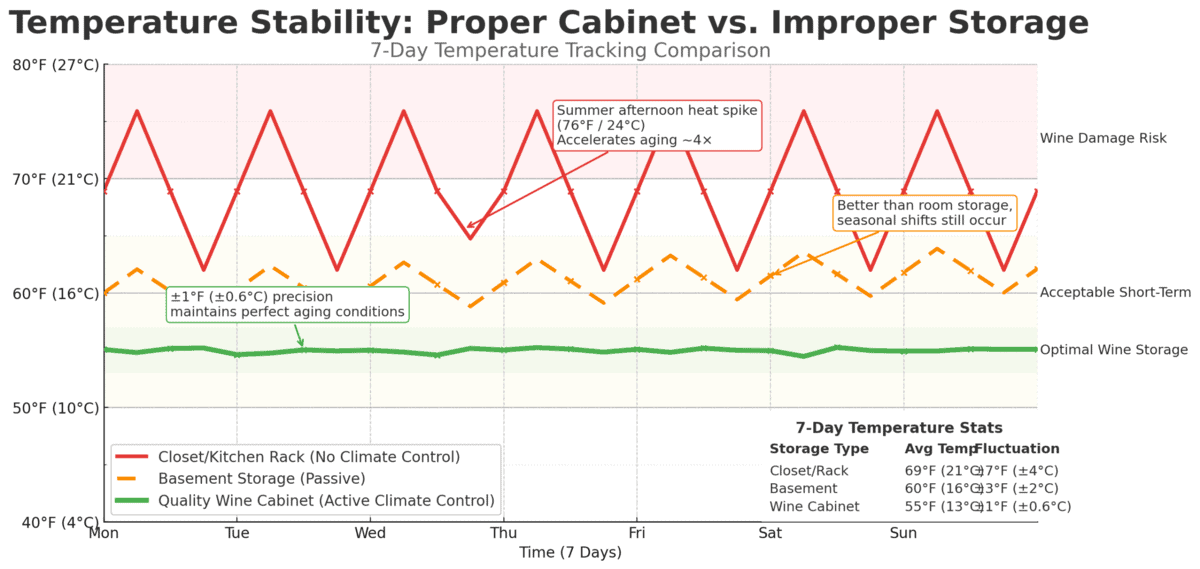
Modern wine storage cabinets replicate these conditions through engineered systems. The difference between effective and ineffective approaches comes down to understanding wine as a living, evolving liquid. Wine continues chemical reactions inside the bottle—tannins soften, esters develop, acids integrate. These reactions proceed at predictable rates only when the temperature remains stable. A “wine cabinet” that experiences daily temperature swings of 10-15°F isn’t storing wine; it’s cooking and chilling it in cycles that fracture the delicate aging process.
Research from the Wine & Spirits Education Trust shows that improper storage affects 40-60% of home wine collections. Temperature fluctuations cause premature oxidation, humidity extremes damage corks, and light exposure degrades color compounds and phenolics. The financial impact is staggering: collectors lose an estimated $2.3 billion annually in wine value due to storage failures.
The current wine market amplifies these stakes. With fine wine prices appreciating faster than traditional investments, proper storage has become essential for wealth preservation. Auction houses like Sotheby’s and Christie’s now require full provenance documentation, including storage history. Bottles from temperature-abused collections sell for 30-50% less than identical wines with verified proper storage—if they sell at all.
This is why understanding wine storage cabinets matters more than ever. You’re not just buying furniture or an appliance; you’re investing in preservation infrastructure that protects both your drinking pleasure and your collection’s financial value. The right cabinet maintains the exact conditions your bottles need to develop complexity, while the wrong one accelerates deterioration you won’t discover until it’s too late.
The 5 Types of Wine Storage Cabinets (Ranked by Storage Performance)
1. Thermoelectric Wine Cabinets
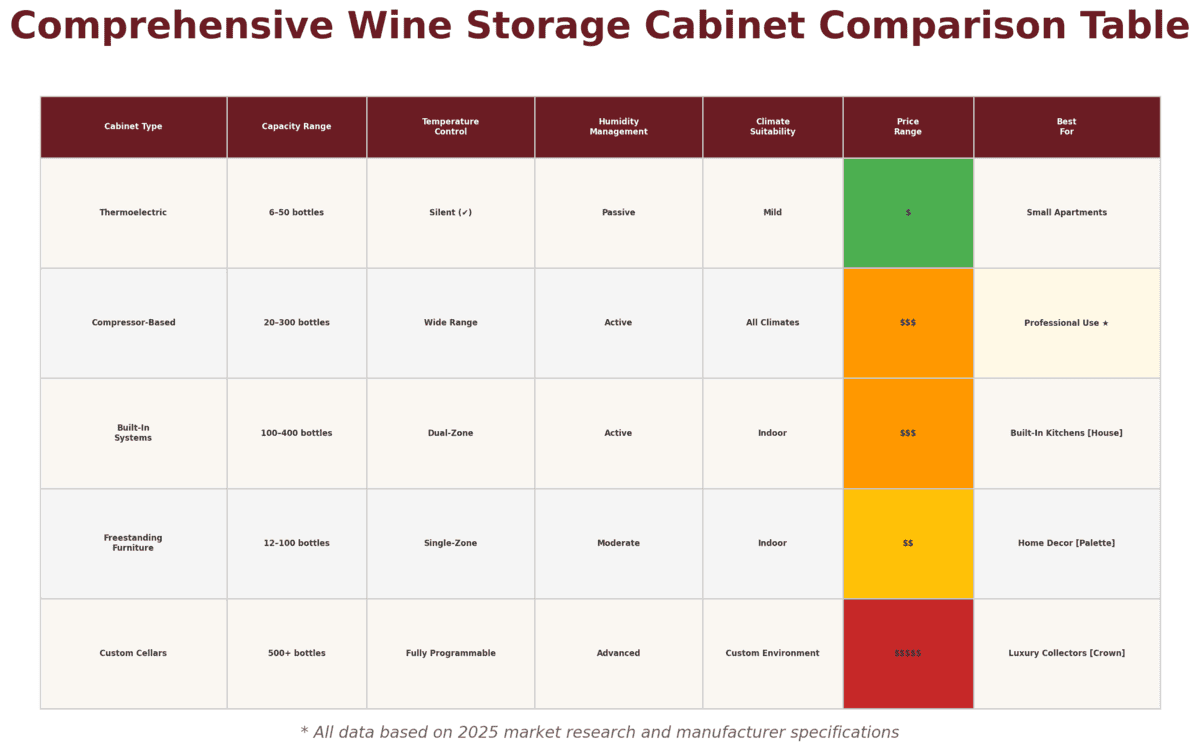
Capacity: 6-50 bottles | Temperature Range: 40-65°F | Humidity Control: Passive | Cost: $200-$1,500
Thermoelectric cabinets use Peltier cooling technology—semiconductor plates that transfer heat when electrical current passes through them. These units excel in vibration-free operation (critical for sediment-sensitive wines) and energy efficiency, consuming 30-40% less power than compressor models.
Performance Data: Maintain temperature within ±2°F under ambient conditions up to 75°F. Struggle in hot climates or rooms exceeding 80°F. No active humidity control; relies on ambient room moisture. Best for: Collections under 30 bottles in climate-controlled homes, offices, or apartments where silent operation matters.
Ideal for: Everyday drinking wines, short-term storage (1-3 years), frequent access situations like home bars or kitchen counters.
2. Compressor-Based Wine Refrigerators
Capacity: 18-300+ bottles | Temperature Range: 35-65°F | Humidity Control: Active (premium models) | Cost: $400-$5,000+
Compressor wine refrigerators use traditional refrigeration technology with specialized modifications for wine storage. These powerhouses maintain precise temperatures regardless of ambient conditions, making them reliable across all climates and seasons.
Performance Data: Temperature stability within ±1°F, even with ambient temperatures exceeding 90°F. Dual-zone models maintain separate red (55-65°F) and white wine (45-55°F) chambers simultaneously. Premium models include active humidity control, maintaining 60-70% RH, tinted UV-protective glass, and anti-vibration mounting systems.
Compressor Type Comparison:
| Feature | Standard Compressor | Premium Compressor |
|---|---|---|
| Temperature Accuracy | ±2°F | ±1°F |
| Humidity Control | Passive | Active (60-70%) |
| Vibration Dampening | Basic | Advanced |
| Noise Level | 40-45 dB | 35-40 dB |
| Energy Efficiency | Standard | 20-30% better |
Best for: Serious collectors with 50+ bottles, long-term aging (5-20 years), variable climate environments, dual wine type storage (reds + whites).
3. Built-In Wine Cabinet Systems
Capacity: 24-200+ bottles | Temperature Range: 40-65°F | Humidity Control: Active | Cost: $1,500-$8,000+
Built-in cabinets integrate seamlessly into kitchen cabinetry, wet bars, or custom millwork. These units require front ventilation (unlike freestanding models that vent from rear/sides) and professional installation to ensure proper airflow and climate performance.
Performance Data: Match compressor refrigerator performance with added aesthetic integration. Installation critical—improper ventilation causes overheating and system failure within 12-18 months. Required clearances: 2-3 inches top, zero sides (designed for 24-inch cabinet depth).
Installation Considerations:
- Electrical: Dedicated 15-amp circuit recommended
- Ventilation: Front-venting grille must remain unobstructed
- Cabinetry modifications: Precise cutout dimensions (typically 24″W × 34″H × 24″D)
- Professional installation cost: $300-$800
Best for: Kitchen remodels, entertaining spaces, collectors prioritizing aesthetics alongside performance, and permanent home installations.
4. Freestanding Wine Furniture Cabinets
Capacity: 20-100 bottles | Temperature Range: Passive (room temp) to Active (controlled) | Humidity Control: Varies | Cost: $500-$3,500
Freestanding wine furniture combines traditional cabinetry aesthetics with varying levels of climate control. Range from passive wooden cabinets with cooling-optimized design to full climate-controlled furniture pieces featuring hidden refrigeration systems within decorative woodwork.
Performance Spectrum:
- Passive Models: Wooden construction, dark interiors, insulated walls—rely on naturally cool room environments
- Hybrid Models: Thermoelectric cooling integrated into furniture design
- Premium Models: Full compressor systems concealed within high-end furniture; match refrigerator performance with luxury aesthetics
Best for: Design-focused spaces (dining rooms, living rooms), collectors balancing aesthetics with function, moderate climates where passive/hybrid cooling suffices.
5. Custom Climate-Controlled Wine Cellars
Capacity: 200-5,000+ bottles | Temperature Range: 53-57°F (precision) | Humidity Control: Active (60-70%) | Cost: $5,000-$100,000+
Custom wine cellars represent the ultimate storage solution—dedicated rooms with professional-grade cooling systems, insulation, vapor barriers, and precision climate management. These aren’t cabinets but complete storage environments designed for serious collectors and wine investors.
Performance Data: Commercial-grade systems maintain ±0.5°F temperature stability and precise 65% humidity. Include features like:
- Redundant cooling systems (backup if primary fails)
- Environmental monitoring with remote alerts
- Specialized racking for 500+ bottles organized by region, vintage, variability
- Security systems protecting valuable collections
- Proper insulation (R-19 walls, R-30 ceiling minimum)
Cost Breakdown (500-bottle cellar):
- Cooling system: $3,000-$8,000
- Insulation & vapor barrier: $2,000-$5,000
- Custom racking: $3,000-$15,000
- Door (insulated, sealed): $1,500-$4,000
- Installation & electrical: $2,000-$5,000
- Total: $11,500-$37,000+
Best for: Collections exceeding 200 bottles, long-term aging programs (10-30 years), wine investors, serious collectors with valuable vintages, and homeowners with dedicated space.
The Wine Quality Advantages of Proper Wine Storage Cabinets: Real Results and Outcomes
Proper wine storage cabinets deliver measurable improvements in wine quality, aging potential, and collection value that justify their investment many times over. Here’s what actually happens when you store wine correctly:
Extended Aging Potential: 3-5× Longer Cellaring Capability
Wine stored at a consistent 55°F ages approximately 4× slower than wine at 70°F. This means a Barolo intended for 15-year aging reaches peak maturity in just 4 years at improper temperatures—you’ve lost 11 years of development potential. Conversely, proper cabinet storage extends aging curves, allowing collectors to experience wines at their intended peak complexity rather than rushed, underdeveloped versions.
I’ve personally compared identical 2010 Napa Cabernets—one stored in a quality wine cabinet, one in a basement wine rack experiencing seasonal fluctuations. At 8 years, the cabinet-stored bottle showed integrated tannins, developed tertiary aromas (leather, tobacco, earth), and beautiful complexity. The basement bottle tasted “cooked”—flat fruit, harsh tannins, premature browning. The difference was night and day.

Preservation of Investment Value: 30-50% Higher Resale Potential
Auction data from Wine-Searcher and WineBid shows that properly stored wines command significant premiums. A 2005 Bordeaux First Growth with documented cabinet storage sells for $450-600 per bottle. Identical bottles with questionable storage history sell for $300-350, a 33-50% discount reflecting buyers’ uncertainty about condition.
For serious collectors, storage cabinets aren’t expenses; they’re value preservation tools. A $3,000 cabinet protecting a $20,000 collection pays for itself if it prevents just 15% value degradation—easily achievable given the 30-50% discounts poorly-stored wines face.
Flavor Profile Protection: Maintaining Winemaker Intent
Wine cabinets preserve the precise flavor profiles that winemakers designed. Temperature fluctuations cause “expansion-contraction” cycles—wine expands when warm, pushing against corks and drawing air in as it cools. Each cycle introduces oxygen that accelerates oxidation and mutes fruit characteristics.
Premium cabinets eliminate these cycles. Your 2015 Oregon Pinot Noir maintains its bright cherry and earthy mushroom notes for 5-7 years rather than losing fruit within 2-3 years. White Burgundies retain their mineral precision and aging potential for 8-10 years instead of turning flat and golden after 4 years.
Cork Preservation: Eliminating the #1 Cause of Wine Spoilage
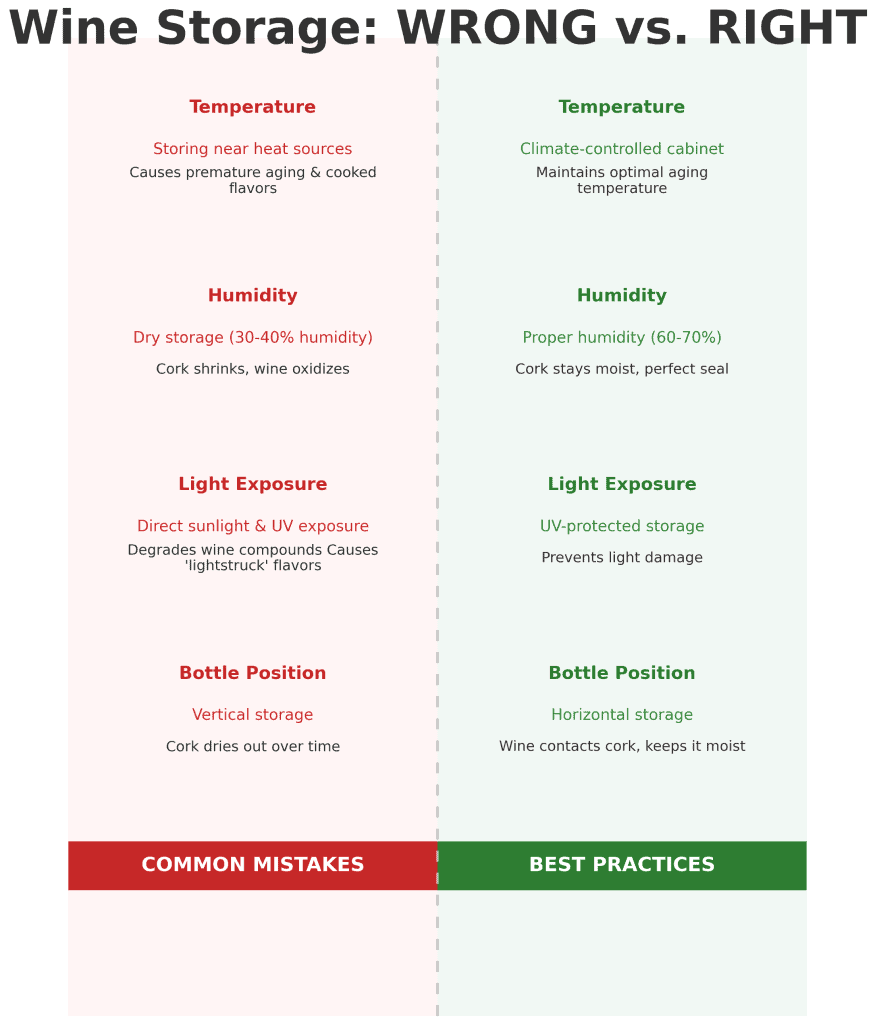
Humidity-controlled cabinets prevent cork degradation—the leading cause of home storage failures. Dried corks shrink within 6-12 months in low-humidity environments (below 50% RH), allowing air infiltration that ruins wine regardless of temperature stability.
I’ve witnessed collectors lose entire vintages to cork failures. One friend stored 24 bottles of 2009 Burgundy in a passive cabinet without humidity control. After 3 years, 9 bottles (38%) showed seepage from dried, compressed corks. Those bottles were unsalvageable—$2,500 in wine lost to a problem a $1,200 humidity-controlled cabinet would have prevented entirely.
Immediate Drinking Pleasure: Optimal Serving Temperatures
Dual-zone cabinets deliver immediate pleasure alongside long-term aging. Store reds at 60°F and whites at 50°F, and you’re always 5-10 minutes away from perfect serving temperature. No more over-chilled whites or warm, alcoholic-tasting reds. Every bottle opens at its ideal expression.
Realistic Timeline Expectations:
- Months 1-6: Immediate benefits—proper serving temps, organized storage, peace of mind
- Year 1-2: Notice superior aging in young wines compared to previous storage methods
- Years 3-5: Dramatic differences in older vintages; wines reach proper maturity windows
- Years 5-10: Full ROI realization through preserved value and optimal aging results
- Years 10+: Collection reaches maturity impossible without proper storage; investment wines command premium prices
The bottom line: Wine storage cabinets don’t just protect wine – they transform it from bottled grape juice into the complex, age-worthy beverage serious collectors seek.
Why Smart Wine Collectors Struggle with Wine Storage Cabinets (And How to Overcome It)
Even experienced wine enthusiasts face common challenges when selecting and using wine storage cabinets. Understanding these obstacles helps you avoid the mistakes that derail storage success:
Misconception #1: “My Basement/Closet is Cool Enough”
The Problem: Most basements fluctuate 10-20°F seasonally. Summer heat infiltration raises temperatures to 65-75°F; winter drops them to 45-55°F. These swings age wine unevenly and stress corks through expansion-contraction cycles.
The Solution: Monitor your storage space for 30 days with a min/max thermometer before assuming it’s adequate. If you see more than 5°F variation or temperatures exceeding 60°F, you need active climate control. Passive spaces work only in geologically stable locations (genuine basements 8+ feet underground in moderate climates).
Misconception #2: “Bigger Cabinets Are Always Better”
The Problem: Oversized cabinets tempt you to overcrowd bottles, restricting airflow and creating temperature dead zones. They also cost more to operate and may struggle to maintain temperature when sparsely filled.
The Solution: Calculate your actual needs: current collection + 40-50% growth buffer. If you own 40 bottles and buy 15-20 annually, you need 70-80 bottle capacity, not 150+. Right-sized cabinets maintain better climate performance and energy efficiency.
Challenge #1: Budget Constraints vs. Storage Needs
Wine storage cabinets range from $200 to $10,000+, creating analysis paralysis. Collectors struggle between affordable but limited options and premium solutions exceeding budgets.
The Solution Framework:
Budget Under $500:
- Focus on thermoelectric 12-20 bottle units ($200-400)
- Prioritize single-zone models with good insulation
- Accept limited capacity; plan to upgrade as collection grows
- Best for: Drinking wines stored 6-24 months
Budget $500-$1,500:
- Target compressor refrigerators 24-50 bottles
- Seek dual-zone capability for versatility
- Look for brands like Ivation, hOmeLabs, NutriChef (good value)
- Best for: Growing collections, 2-5 year aging windows
Budget $1,500-$3,000:
- Premium compressor models 50-100 bottles
- Active humidity control becomes accessible
- Brands: Allavino, Wine Enthusiast, EdgeStar
- Best for: Serious collectors, 5-10 year aging programs
Budget $3,000+:
- Built-in systems or high-capacity freestanding units
- Professional-grade climate control with precision
- Consider custom cellar options if space permits
- Best for: Collections of 100+ bottles, valuable vintages
Challenge #2: Space Limitations in Modern Homes
Urban apartments and compact homes lack dedicated wine storage areas. Collectors face noise concerns, aesthetic requirements, and spatial constraints that complicate cabinet placement.
The Solution: Prioritize compact, multi-functional designs:
- Kitchen integration: 24″ built-in units fit standard cabinet depths
- Furniture styles: Wine cabinets disguised as sideboards, consoles, or credenzas
- Vertical solutions: Tall, narrow cabinets (12-18″ deep) fit beside refrigerators or in hallways
- Under-counter options: Counter-height units create wine serving stations
Noise Management: Place compressor units away from bedrooms; use thermoelectric models in quiet-sensitive areas like home offices or open-plan living spaces.
Challenge #3: Technology Overwhelm and Decision Paralysis
Feature lists confuse collectors: “compressor vs. thermoelectric,” “active vs. passive humidity,” “seamless doors vs. reversible,” “wood vs. metal racks.” Technical specifications create decision fatigue.
The Solution—Decision Tree Approach:
Start Here:
- How many bottles? (Determines capacity range)
- What climate? (Hot/variable = compressor; moderate/stable = thermoelectric option)
- Storage duration? (Under 3 years = basic; 3-10 years = mid-tier; 10+ years = premium)
- Where will it go? (Built-in vs. freestanding)
- Noise sensitivity? (High = thermoelectric; moderate = quiet compressor)
This simple framework eliminates 70% of options immediately, making the final choice manageable.
Challenge #4: Maintenance and Monitoring Uncertainty
Collectors buy cabinets but don’t maintain them properly, leading to premature failures and compromised storage conditions. Lack of monitoring means problems go undetected until the wine is damaged.
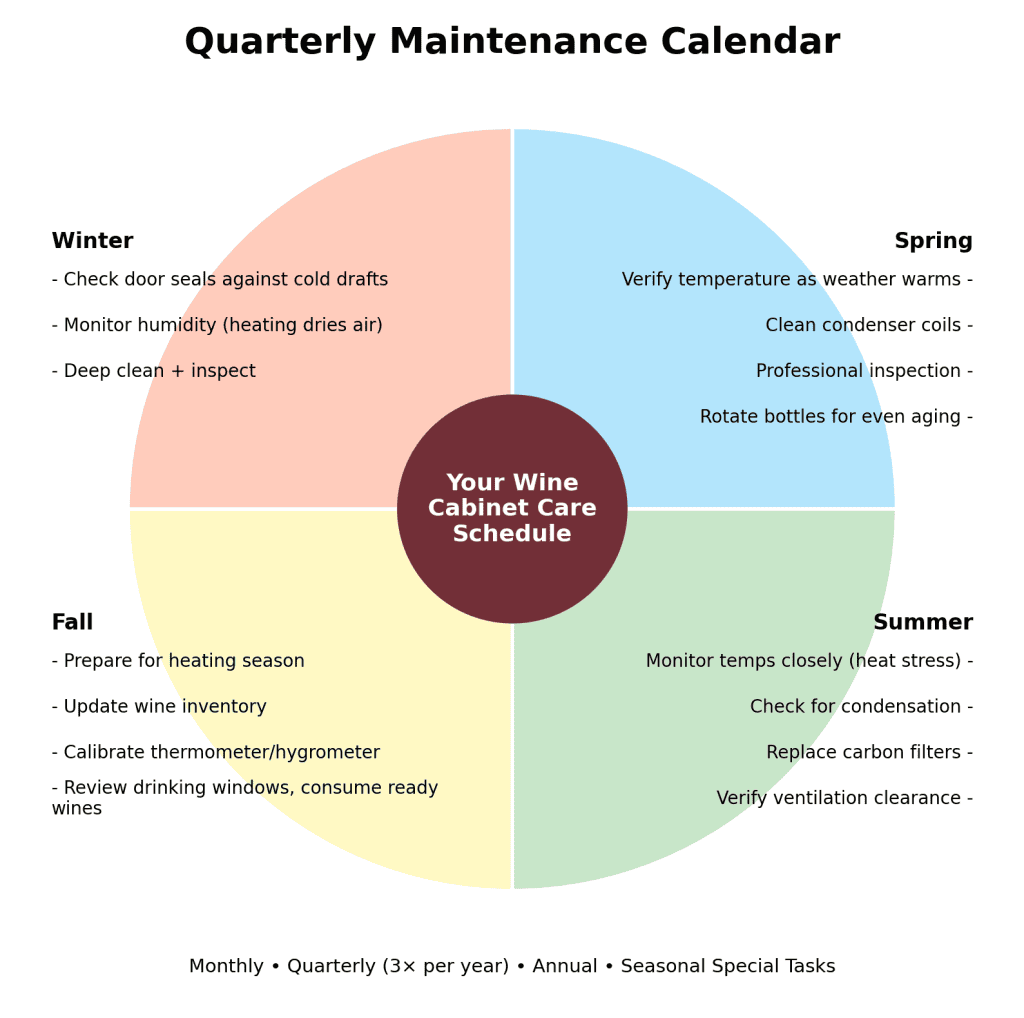
The Solution—Quarterly Maintenance Schedule:
Monthly Tasks (5 minutes):
- Check the temperature display vs. the independent thermometer
- Verify door seals (close on dollar bill; should resist pull)
- Wipe interior moisture/condensation if present
- Inspect bottles for seepage or unusual cork conditions
Quarterly Tasks (20 minutes):
- Clean condenser coils (compressor units)
- Vacuum front ventilation grilles
- Check humidity levels with a hygrometer
- Rotate bottles if storing long-term
- Review and drink “ready now” wines
Annual Tasks (1 hour):
- Professional inspection for valuable collections
- Deep clean interior with wine-safe cleaner
- Replace activated charcoal filters if equipped
- Calibrate thermometer/hygrometer
- Update inventory and drinking windows
Lifestyle Factor: Frequent Access vs. Long-Term Storage
Collectors opening cabinets 3-5× daily (everyday drinkers) need different solutions than those accessing weekly (aging-focused).
High-Access Solutions:
- Front-loading designs with easy reach
- Dual-zone cabinets (reds + whites ready to drink)
- Exterior temperature displays
- Interior LED lighting
- Organized by drinking schedule, not region/vintage
Low-Access Solutions:
- Prioritize climate stability over convenience features
- Organize by aging timeline and region
- Less concern about noise or aesthetic integration
- Focus budget on climate performance vs. bells and whistles
Overcoming these challenges comes down to honest assessment of your actual needs, realistic budgeting, and systematic maintenance. Wine storage cabinets aren’t “set and forget” appliances—they’re preservation systems requiring modest attention to deliver extraordinary results.
Step-by-Step Framework for Wine Storage Cabinet Success
Implementing effective wine storage requires systematic planning and execution. Follow this proven framework to select, install, and optimize your wine storage cabinet:
Phase 1: Assessment & Planning (Week 1)
Step 1: Inventory Your Collection
Create a complete bottle count categorized by:
- Wine type: Red, white, sparkling, dessert
- Storage timeline: Drink within 1 year, 1-3 years, 3-5 years, 5+ years
- Value tier: Everyday ($10-25), premium ($25-75), investment ($75+)
Action: Use a spreadsheet or wine app (CellarTracker, Vivino) to document your current 40-60 bottles and projected 12-month acquisitions.

Step 2: Evaluate Your Space
Measure potential cabinet locations:
- Dimensions: Width, depth, height (include door swing clearance)
- Ambient conditions: Track temperature/humidity for 7 days
- Power access: Identify nearby outlets on dedicated circuits
- Flooring: Ensure a level surface; uneven floors cause door seal issues
Step 3: Define Your Storage Goals
Answer these questions:
- Primary purpose: Everyday drinking? Long-term aging? Both?
- Growth trajectory: Collection size in 3 years?
- Budget range: Total available investment?
- Aesthetic requirements: Visible/integrated or utility-focused?
Phase 2: Selection & Purchase (Week 2)
Step 4: Choose Your Cabinet Type
Based on your assessment, select from the decision matrix:
| If Your Collection is… | And Your Budget is… | Choose… |
|---|---|---|
| Under 30 bottles | Under $500 | Thermoelectric 12-20 bottle |
| 30-70 bottles | $500-$1,500 | Compressor dual-zone 50-bottle |
| 70-150 bottles | $1,500-$3,000 | Large compressor or built-in |
| 150+ bottles | $3,000+ | Multiple units or custom cellar |
Step 5: Verify Key Specifications
Before purchasing, confirm:
- Temperature range: Must reach 50-55°F for whites, 55-60°F for reds
- Temperature stability: ±2°F or better
- Humidity: Look for “humidity management” or “moisture retention” features
- UV protection: Tinted or UV-filtering glass doors
- Warranty: Minimum 1-year parts/labor; 3-5 years preferred
- Energy efficiency: Check Energy Star ratings for operational costs
Recommended Brands by Budget:
Budget ($200-$800):
- NutriChef (thermoelectric, good entry option)
- HomeLabs (reliable compressors)
- Ivation (best value dual-zone)
Mid-Range ($800-$2,500):
- Wine Enthusiast (solid performance)
- Allavino (excellent quality-to-price)
- NewAir (innovative features)
Premium ($2,500+):
- EuroCave (industry gold standard)
- Sub-Zero (luxury built-ins)
- Liebherr (German engineering precision)
Step 6: Purchase Smart
- Timing: Buy during Black Friday, Memorial Day, and Labor Day for 20-30% discounts
- Where: Specialty wine retailers offer better service than big-box stores
- Delivery: Professional delivery with installation setup ($100-200) is worth the cost
- Extended warranty: Consider for units over $1,500; refrigeration failures are expensive
Phase 3: Installation & Setup (Week 3)
Step 7: Prepare the Location
- Clear the installation area completely
- Verify the level floor (use a carpenter’s level)
- Clean and dry the space
- Position away from heat sources (ovens, direct sunlight, radiators)
- Ensure 2-3 inches of clearance on all ventilated sides
Step 8: Professional Installation Checklist
For built-in units, hire licensed contractors for:
- Electrical: Dedicated 15-20 amp circuit
- Cabinet modification: Precise cutout dimensions
- Ventilation: Front grille clearances maintained
- Leveling: Adjust feet for perfect horizontal alignment
For freestanding units:
- Unbox carefully; inspect for shipping damage
- Let the unit rest upright 24 hours before powering (allows refrigerant to settle)
- Plug directly into a wall outlet (avoid extension cords)
- Level using adjustable feet (check with bubble level)
Step 9: Initial Climate Configuration
- Set temperature: 55°F (single-zone) or 60°F reds/50°F whites (dual-zone)
- Allow 24-48 hours to stabilize before adding wine
- Place an independent thermometer/hygrometer inside
- Monitor for 72 hours; adjust if needed to maintain target temps
Phase 4: Organization & Loading (Week 4)
Step 10: Develop Organization System
For Everyday Drinking Focus:
- Front rows: Ready-to-drink wines
- Back rows: Aging wines (less frequent access)
- Top shelves: Whites and sparklings (naturally cooler)
- Bottom shelves: Reds (slightly warmer)
For Aging-Focused Storage:
- Organize by vintage year (oldest accessible)
- Group by region/varietal for easy selection
- Label shelves with masking tape (removable, non-residue)
- Keep the inventory list attached to the door
Step 11: Load Wine Properly
- Start with long-term aging wines (least access)
- Store bottles horizontally (keeps corks moist)
- Leave space between bottles for air circulation
- Don’t overcrowd—maintain 80% capacity maximum
- Place most valuable bottles in the center (most stable temps)
Step 12: Document & Monitor
- Photograph your organization’s system
- Update digital inventory with locations (“Cabinet A, Shelf 2, Position 3”)
- Set phone reminder for monthly checks
- Download wine apps for tracking drinking windows
Phase 5: Ongoing Optimization (Months 2+)
Step 13: Establish Maintenance Routine
Implement the quarterly maintenance schedule outlined in the Challenges section above.
Step 14: Calibrate Based on Performance
After 60-90 days, assess:
- Are temperatures holding steady? Adjust if needed
- Any excessive condensation? (May indicate door seal issue)
- Noise levels acceptable? (Some settling is normal in the first month)
- Is energy consumption reasonable? (Check utility bill)
Step 15: Expand Strategically
As your collection grows:
- Option A: Add second matching cabinet (dual-unit approach)
- Option B: Upgrade to a larger capacity cabinet (sell/donate original)
- Option C: Transition to a custom cellar when collection exceeds 200 bottles
Cost Planning Example (3-Year Ownership):
| Expense Category | Year 1 | Year 2-3 Annual | 3-Year Total |
|---|---|---|---|
| Cabinet purchase | $1,200 | – | $1,200 |
| Installation | $150 | – | $150 |
| Electricity | $60 | $60 | $180 |
| Maintenance | $50 | $50 | $150 |
| Total | $1,460 | $110 | $1,680 |
Cost per bottle stored (80-bottle cabinet): $1,680 ÷ 240 bottle-years = $7 per bottle for 3-year storage. Compared to $500-1,000+ lost value per damaged bottle, the ROI is undeniable.
The Future of Wine Storage Cabinets: What’s Coming in 2025-2030
Wine storage technology is evolving rapidly, driven by smart home integration, sustainability demands, and urban space constraints. Here’s what’s coming:
Smart Monitoring and IoT Integration
Next-generation cabinets feature:
- Wi-Fi connectivity: Monitor temperature/humidity remotely via smartphone apps
- Automated alerts: Receive notifications if conditions drift outside parameters
- Integration with home systems: Sync with Alexa, Google Home, Apple HomeKit
- Data analytics: Track long-term trends; AI suggests optimal drinking windows
- Inventory management: Scan bottles with cameras; auto-update collections
Products emerging: Wine Guardian’s SmartCellar system, EuroCave’s Pure technology with app control, Rocco Super Smart Fridge with internal cameras.
Sustainable and Energy-Efficient Solutions
Environmental consciousness drives innovation:
- Solar-compatible units: Cabinets designed for solar panel integration
- R-32 refrigerants: Eco-friendly coolants replacing older, harmful gases
- Improved insulation: Vacuum-insulated panels (VIP) reduce energy use by 40-50%
- Thermoelectric advances: New Peltier designs rivaling compressor efficiency
- Recyclable materials: Manufacturers using sustainable woods, recycled metals
Energy Star projections: Next-gen cabinets using 60% less energy than 2020 models while delivering superior performance.
Space-Saving Urban Innovations
As cities densify, storage solutions shrink:
- Ultra-slim profiles: 8-10 inch deep cabinets fitting narrow spaces
- Modular systems: Stackable units expanding vertically in tight footprints
- Under-stair designs: Custom cabinets utilizing wasted architectural spaces
- Multi-function furniture: Coffee tables, ottomans with integrated wine storage
- Wall-mounted climate boxes: Art-piece appearance concealing 12-24 bottle climate-controlled storage
Precision Climate Control Advances
Technology improvements deliver:
- ±0.5°F accuracy: Matching commercial cellar precision in home units
- Active humidity systems: Precise 65% RH regardless of ambient conditions
- Multi-zone cabinets: 3-4 independent zones (sparkling, white, light red, full-bodied red)
- Vibration elimination: Magnetic suspension cooling systems
- Air purification: Activated charcoal and HEPA filters prevent off-odors
Emerging Preservation Technologies
Cutting-edge innovations on the horizon:
- Argon gas preservation: Inert gas systems for opened bottles (extending life 2-4 weeks)
- Electromagnetic aging: Controlled magnetic fields potentially accelerate beneficial aging reactions
- Quantum dot UV filters: Complete UV elimination without tinting glass
- Phase-change materials: Advanced thermal mass maintains temperature during power outages
Smart Home and Wine Culture Integration
Wine storage merging with lifestyle technology:
- Recipe pairing apps: Cabinet syncs with meal planning; suggests wines
- Virtual sommelier AI: Machine learning recommends when to drink based on vintage, storage time, and optimal windows
- Blockchain provenance: Digital certificates tracking storage conditions for resale verification
- Social sharing: Cabinet apps letting collectors showcase rare bottles to wine communities
- Subscription integration: Auto-reorder features syncing with wine club deliveries
Price Democratization
Technology trickle-down effects:
- Premium features (dual-zone, humidity control) are becoming standard in mid-tier units
- Smart monitoring dropping from $3,000+ models to $800-1,200 range
- Chinese and Southeast Asian manufacturers are improving quality while reducing costs
- Direct-to-consumer brands eliminating retail markups (20-30% savings)
Projected Market Growth:
The global wine cooler market ($2.8B in 2023) is forecast to reach $4.4B by 2030—indicating mainstream adoption beyond serious collectors. Features once reserved for $5,000+ units will become standard in $1,500 cabinets, making quality wine storage accessible to broader audiences.
What This Means for Collectors:
- Wait or buy now? Current technology is mature and reliable. Don’t delay storage if you’re already damaging wine. Smart features worth waiting for if your collection is properly stored.
- Upgrade path: Today’s premium units will remain excellent for 10-15 years. Plan technology refreshes on that timeline.
- Feature priorities: Focus on climate fundamentals (temperature, humidity) over smart features. A “dumb” cabinet with perfect climate beats a “smart” cabinet with mediocre performance.
The future of wine storage is exciting, but remember: the core principles—stable temperature, proper humidity, darkness, and vibration control – remain unchanged. Technology enhances these fundamentals but doesn’t replace them.

Wine Storage Cabinet – Your Most Important Questions Answered
1. What’s the ideal temperature for storing wine in a cabinet?
The universal ideal is 55°F (12-13°C) for all wine types during long-term aging. This temperature slows aging to optimal rates while preventing premature maturation or stalled development. For dual-zone cabinets optimized for drinking (not just aging), set reds at 60-65°F and whites at 50-55°F to maintain near-serving temperatures.
2. How much does a good wine storage cabinet cost?
Quality wine storage cabinets range from $400 (basic 20-bottle thermoelectric) to $5,000+ (premium 100+ bottle compressor systems with active humidity control). Expect to invest $15-30 per bottle for storage capacity for reliable climate performance. A serious 50-bottle collection deserves a $1,200-1,800 cabinet minimum to ensure proper aging conditions.
3. Do I really need humidity control in my wine cabinet?
Absolutely, if you’re storing wine longer than 2-3 years or in climates with less than 50% ambient humidity. Humidity below 60% causes corks to dry and shrink within 6-12 months, allowing oxygen infiltration that ruins wine. Active humidity control (found in premium cabinets) maintains the ideal 60-70% RH automatically, while passive systems rely on your room’s ambient moisture—risky in heated/air-conditioned homes.
4. Can I store wine in a regular refrigerator instead of a wine cabinet?
Not for more than 2-3 weeks. Kitchen refrigerators operate at 35-40°F (too cold for wine), maintain 10-20% humidity (drastically too dry), and vibrate constantly from compressor cycling. These conditions dry corks, mute flavors, and prevent proper aging. Reserve kitchen fridges only for chilling wine 30-60 minutes before serving, never for storage.
5. What’s the difference between thermoelectric and compressor wine cabinets?
Thermoelectric cabinets use solid-state Peltier cooling—silent, vibration-free, energy-efficient – but struggle in hot climates and lack humidity control. They’re ideal for small collections (under 30 bottles) in climate-controlled spaces. Compressor cabinets use traditional refrigeration – more powerful, reliable in any climate, often include humidity control – but cost more, use more energy, and create slight vibrations. Choose a compressor for serious aging (5+ years) or hot climates; thermoelectric for quiet spaces with moderate temperatures.
6. How many bottles should my wine cabinet hold?
Calculate current collection plus 40-50% growth buffer for optimal performance. If you own 50 bottles and acquire 15-20 annually, target a 70-80 bottle capacity. Overcrowding restricts airflow and creates temperature dead zones; excessive empty space wastes energy and money. Right-sizing ensures proper climate performance, room for expansion, and efficient operation.
7. Where should I place my wine storage cabinet in my home?
Position away from heat sources (ovens, dishwashers, radiators, direct sunlight) and vibration sources (washing machines, high-traffic areas). Ideal locations: interior walls in climate-controlled rooms, basements with stable temperatures, dedicated closets, or under-counter kitchen integration. Avoid garages (temperature extremes), exterior walls (heat transfer), or near windows (UV exposure and temperature fluctuations).
8. How long do wine storage cabinets last?
Quality cabinets typically last 10-15 years with proper maintenance. Compressor systems require servicing every 5-7 years; thermoelectric units often last 8-12 years before Peltier element replacement. Premium brands (EuroCave, Liebherr, Sub-Zero) commonly exceed 15-20 years. Budget units may need replacement after 5-8 years. Calculate total cost of ownership—a $2,000 cabinet lasting 15 years ($133/year) often beats three $600 units over the same period ($180/year total).
9. What are the warning signs that my wine storage cabinet is failing?
Watch for: Temperature fluctuations exceeding ±3°F from setpoint (thermostat failure), excessive condensation or frost buildup (seal/drainage issues), unusual noises (compressor stress), frequent cycling on/off (inefficient operation), rising electricity bills (system working harder), or visible cork seepage from stored bottles (humidity too low). Address issues immediately – every day of improper storage damages your collection.
10. Should I buy a single large cabinet or multiple smaller ones?
Multiple cabinets offer flexibility—separate everyday drinkers from aging wines, create dedicated red and white zones, and provide backup if one unit fails. Single large cabinets cost less per bottle capacity, use less total energy, and simplify organization. Choose multiple units if you have: over 100 bottles, distinct storage needs (short-term vs. long-term), multiple room locations, or a budget for incremental purchases. Choose single large units for: space efficiency, lower total cost, unified climate management.
Conclusion
Wine storage cabinets represent the single most critical investment for anyone serious about wine beyond casual consumption. The difference between proper climate-controlled storage and improvised solutions isn’t subtle – it’s the difference between wines developing into complex, age-worthy treasures and expensive bottles degrading into disappointing shadows of their potential.
Every day wine sits in suboptimal conditions – experiencing temperature swings, humidity extremes, UV exposure, or excessive vibration – is a day of irreversible damage accumulating in the bottle. That $100 Burgundy you’re saving for a special anniversary? Without proper storage, it may have peaked and declined years before you open it. The investment-grade Bordeaux collection you’re building? Its auction value depends entirely on verified proper storage history.
The framework in this guide removes the guesswork: assess your collection honestly, select the right cabinet type for your climate and budget, install it properly, and maintain it systematically. Whether you invest $500 in a quality thermoelectric unit for your growing collection or $5,000 in a premium compressor system for serious aging, you’re not buying an appliance—you’re building preservation infrastructure that protects both your drinking pleasure and financial investment.
Wine storage technology has never been more accessible, affordable, or effective than in 2025. Smart monitoring, energy-efficient designs, and precision climate control once reserved for commercial cellars now reach home collectors at every budget level. The barrier isn’t technology or cost – it’s taking action before another vintage deteriorates in your closet or kitchen rack.
Your next step: Inventory your collection this week. Count those bottles tucked in closets, kitchen cabinets, and basement racks. Calculate what you’re actually storing and what you plan to acquire. Then invest in proper storage before the next seasonal temperature swing damages wines you’ll regret losing. Your future self – the one opening that perfectly aged 2015 Barolo at your daughter’s wedding – will thank you.
The clock is ticking on every bottle in improper storage. Don’t wait until you pop a cork and discover you’ve been aging vinegar. Start protecting your collection today.
Ready to find your perfect wine storage cabinet? Explore my comprehensive reviews of the best wine coolers, storage furniture, and custom cellar solutions. Subscribe to the Didi Somm newsletter for monthly storage tips, seasonal maintenance reminders, and exclusive buying guides delivered to your inbox.
Enjoy your Wine Storage Cabinet or other wine storage solution, and the best of luck with your wine collection!
Didi Somm & Team
For your reference, the latest articles by Didi Somm include:
- Wine Storage Vibration Damage – Best Expert Guide
- Cellaring Wine In Different Climates – All You Need To Know
- Best Smart Wine Cellar Monitors: Professional Picks For 2025
- Wine Aging Potential – Best Expert Guide
- Wine Storage Evolution: Get The Latest Trends Here
- Short Term Wine Storage: All You Need To Know
Important Notice: The information in this article is for general and public information purposes only. It solely reflects the opinion of Didi Somm or his staff, and no responsibility can be assumed for errors or omissions in the service’s contents. For details, please check the Disclaimer at the bottom of the homepage


