Introduction – Best Wine Cabinets For Small Spaces
67% of urban wine collectors abandon their hobby within two years – not because they lose interest, but because they believe they simply don’t have room. If you’ve ever stared at your cramped apartment, galley kitchen, or modest dining area and thought a proper wine collection was out of reach, I have good news: The best wine cabinet for small spaces can transform even the tightest corner into a perfectly climate-controlled sanctuary for your bottles.
I’m Didi Somm, and after more than 15 years of collecting, storing, and occasionally ruining wine (yes, I’ve learned some lessons the hard way), I’ve made it my mission to help wine lovers protect their investments – regardless of their square footage. In this comprehensive guide, I’ll walk you through the seven best compact wine cabinets available in 2026, explain exactly what features matter most when space is limited, and share the hard-won wisdom that’s helped me and thousands of readers store wine properly in everything from studio apartments to tiny home offices.
Whether you’re working with an unused closet corner, the sliver of space beside your refrigerator, or that awkward nook under your stairs, there’s a solution here for you. Let’s find the perfect wine cabinet that fits your space, your collection, and your budget.
Welcome by Didi Somm & Cheers!
Important Notice: The information in this article is for general and public information purposes only. It reflects the opinion of Didi Somm or his staff solely, and no responsibility can be assumed for errors or omissions in the service’s content. For details, please check the Disclaimer at the bottom of the homepage.
Key Takeaways
- Every space can accommodate proper wine storage. From the 10-inch-wide Ivation countertop unit ($220) to the premium EuroCave Premiere S ($3,200), there’s a quality wine cabinet for apartments, closets, kitchens, and tight corners – no wine cellar required.
- Front-venting is essential for built-in installations. If you’re placing a cabinet under a counter, inside cabinetry, or in a closet, choose a front-venting model to prevent overheating and compressor failure.
- Compressor vs. thermoelectric depends on your environment. Compressor units handle warm rooms (up to 86°F) but generate more noise; thermoelectric units run whisper-quiet but struggle above 77°F. Match the technology to your space.
- Prioritize temperature stability over capacity. A smaller cabinet that maintains consistent 55°F temperatures protects your wine better than a larger unit with fluctuations. Quality trumps quantity.
- Budget options work. The $350 NewAir delivers the fundamentals – stable temperature and adequate humidity – proving you don’t need thousands of dollars to properly store wine.

Why Small-Space Wine Storage Requires Special Consideration
Before diving into specific recommendations, it’s worth understanding why you can’t simply buy any wine cabinet and squeeze it into a tight spot. Small-space wine storage presents unique challenges that demand purpose-built solutions.
The Heat Dissipation Problem
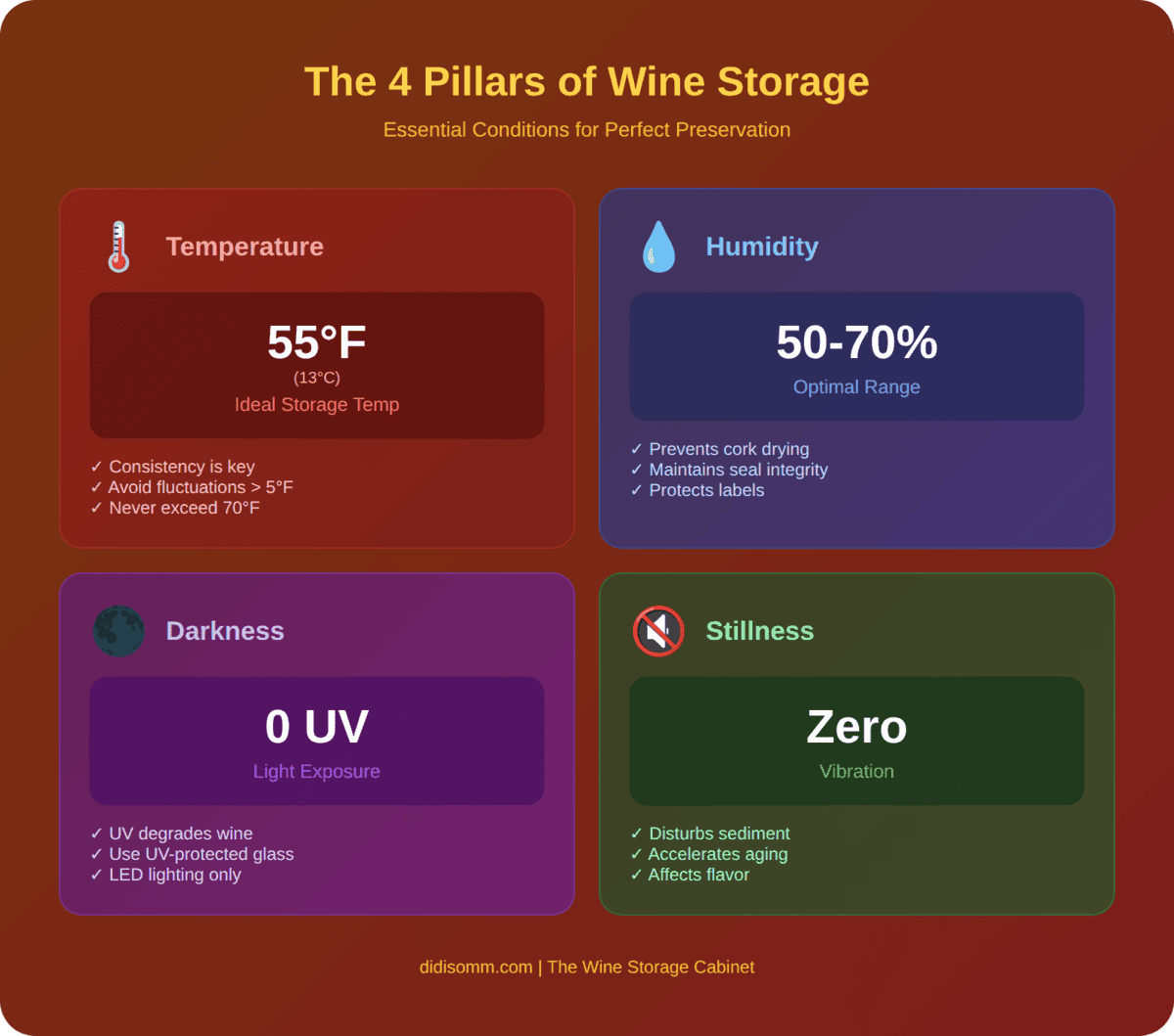
Every wine cabinet generates heat as it works to keep your bottles cool. Larger units in spacious rooms can dissipate this heat easily, but compact cabinets tucked into tight spaces face a different reality. Without adequate ventilation clearance, the compressor works overtime, driving up energy costs and potentially shortening the unit’s lifespan.
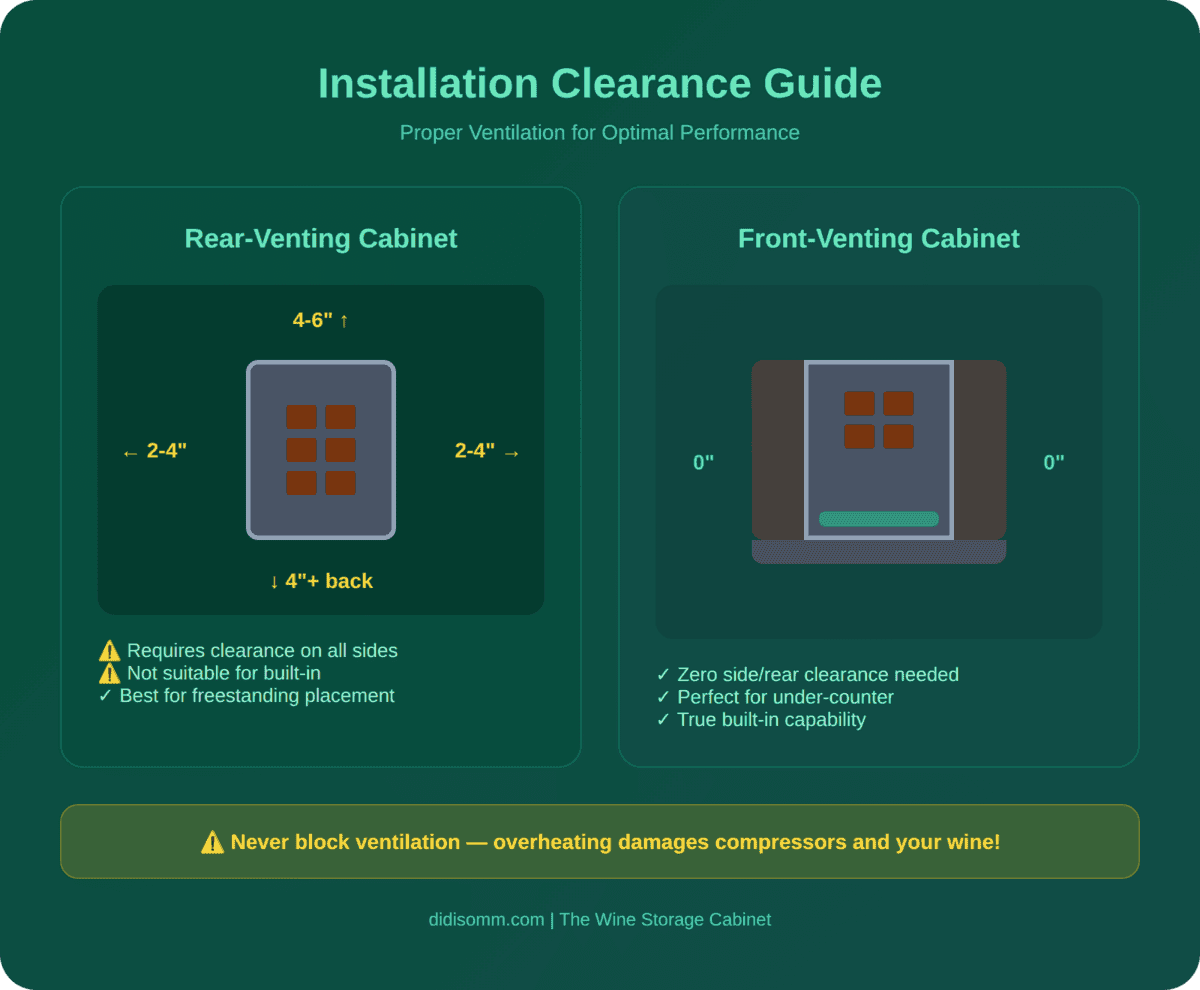
Pro Tip: Always check the manufacturer’s required clearance specifications. Most compact units need 2-4 inches on the sides and back, plus 4-6 inches above. Front-venting models offer the most flexibility for built-in installations.
Capacity vs. Footprint Trade-offs
Manufacturers often advertise bottle capacity under ideal conditions – meaning all standard 750ml Bordeaux bottles stored perfectly. In reality, your collection probably includes Burgundy bottles (wider), Champagne (taller), and maybe some half-bottles or magnums. The best wine cabinet for small spaces maximizes real-world capacity through adjustable shelving and thoughtful interior design.
Noise Considerations
In a spacious basement, a humming compressor goes unnoticed. In a 600-square-foot apartment where your wine cabinet sits six feet from your bed? That same hum becomes a sleep-disrupting annoyance. Compact wine cabinets designed for living spaces prioritize quiet operation – look for units rated under 40 decibels.
What To Look For In a Small-Space Wine Cabinet
When evaluating compact wine cabinets, I assess seven critical factors. Understanding these will help you make a confident decision regardless of which specific model you choose.
1. Cooling Technology: Compressor vs. Thermoelectric
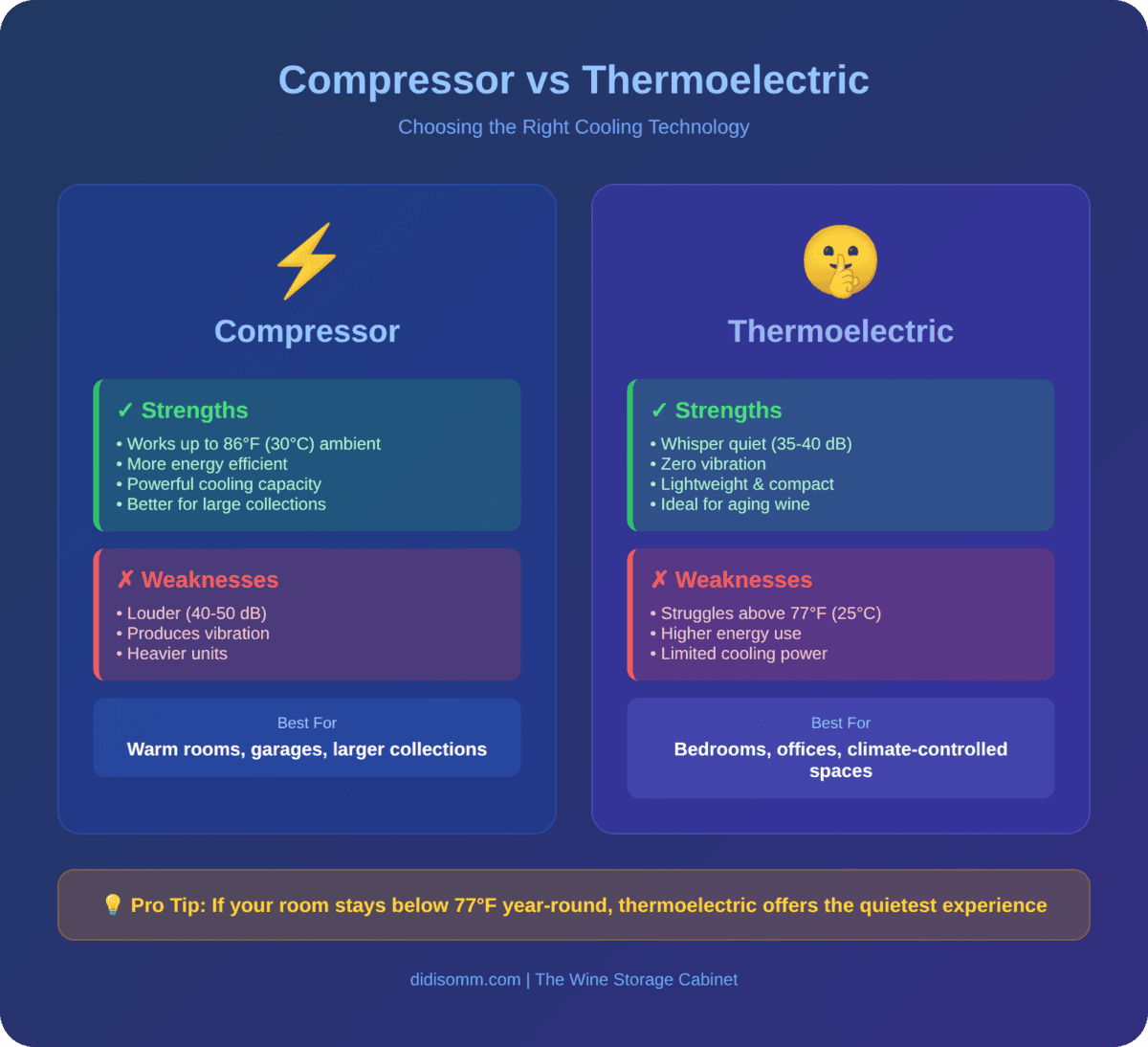
Compressor cooling uses the same technology as your kitchen refrigerator. It’s powerful, efficient, and can maintain consistent temperatures even in warmer ambient environments (up to 86°F/30°C). The trade-off? Compressors generate more noise and vibration.
Thermoelectric cooling uses the Peltier effect to transfer heat without moving parts. These units run whisper-quiet and vibration-free – ideal for aging wine. However, they struggle in warm rooms and consume more energy per degree of cooling (Remark: Please check our recent article “Top 3 Thermoelectric Wine Coolers“)
My recommendation for small spaces: If your room stays below 77°F (25°C), thermoelectric offers the quietest experience. Otherwise, choose a quality compressor unit with vibration-dampening.
2. Ventilation Type
- Front-venting: Heat exhausts through the front grille, allowing true built-in installation with zero side or rear clearance. Essential for under-counter placement or tight cabinetry integration.
- Rear-venting: Requires clearance behind and, in some cases, beside the unit. Better suited for freestanding placement.
3. Temperature Zones
- Single-zone: Maintains one temperature throughout. Ideal if you primarily collect one type of wine or focus on long-term aging (store everything at 55°F/13°C).
- Dual-zone: Separate compartments for reds and whites at different temperatures. Better for collectors who want bottles ready to serve.
For small collections in limited space, I generally recommend single-zone units – they’re more space-efficient and simpler to manage.
4. Shelving Flexibility
Look for:
- Adjustable shelf heights to accommodate different bottle shapes
- Sliding or roll-out shelves for easy access
- Removable shelves to create space for magnums or odd-sized bottles
5. Door Style and Seal Quality
Glass doors look beautiful and let you admire your collection, but ensure they feature UV protection to prevent light damage. Solid doors offer better insulation and temperature stability. Regardless of style, check that the door seal is tight – a poor seal is the number one cause of temperature fluctuations and increased energy consumption.
6. Noise Level
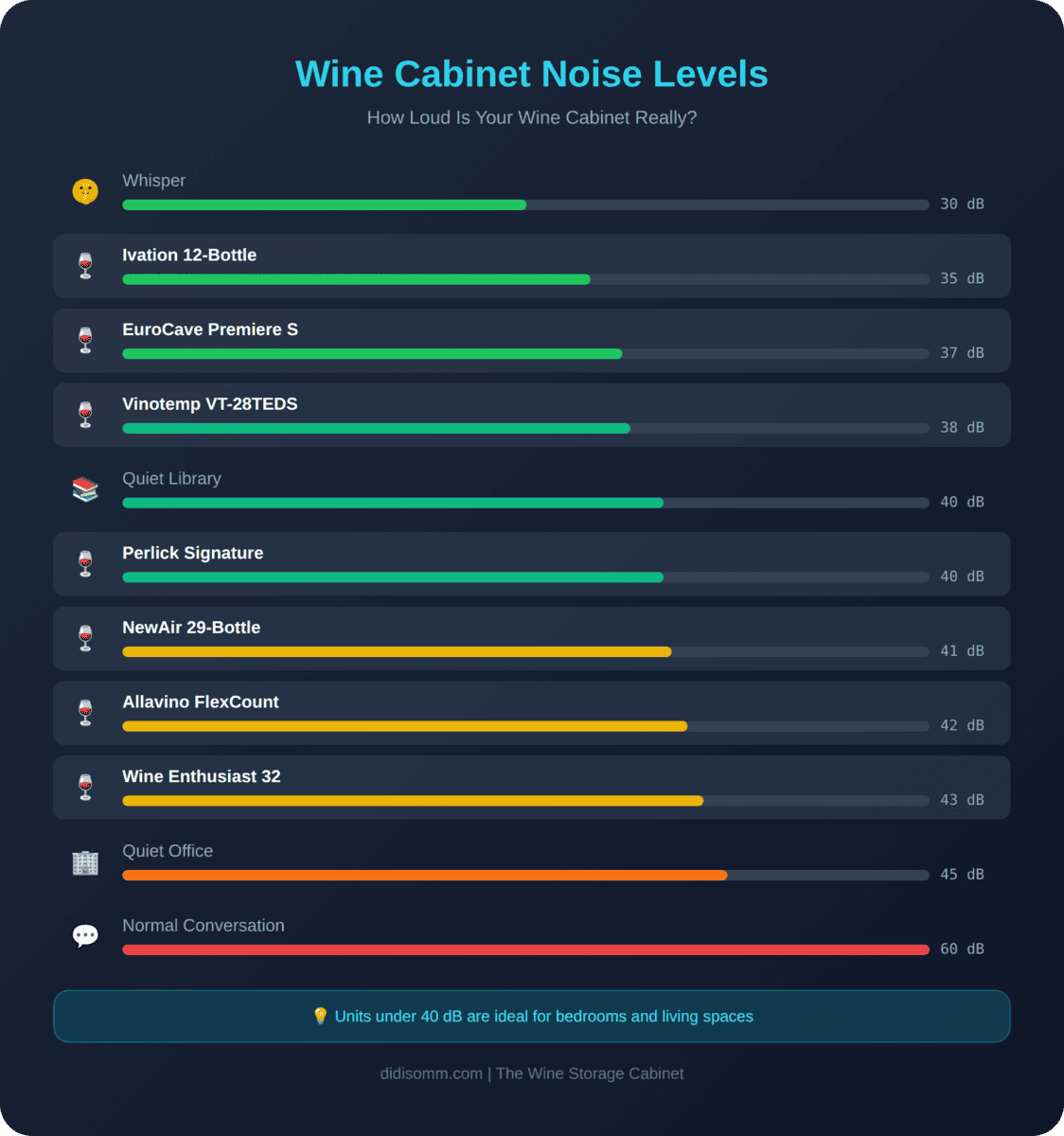
Units under 40 dB are comparable to a quiet library. Units at 45 dB or above become noticeable in living spaces. Always check the specification sheet, and when possible, read user reviews specifically commenting on real-world noise levels.
7. Energy Efficiency
Compact wine cabinets typically consume 70-150 kWh annually. At average electricity rates, that’s $10-20 per year. Energy Star certification indicates above-average efficiency, though few small wine cabinets carry this designation.
The 7 Best Wine Cabinets For Small Spaces in 2026
After testing dozens of units and analyzing hundreds of owner reviews, these seven models represent the best wine cabinets for small spaces across different budgets, capacities, and use cases.
1. Best Overall: EuroCave Premiere S (74 bottles)
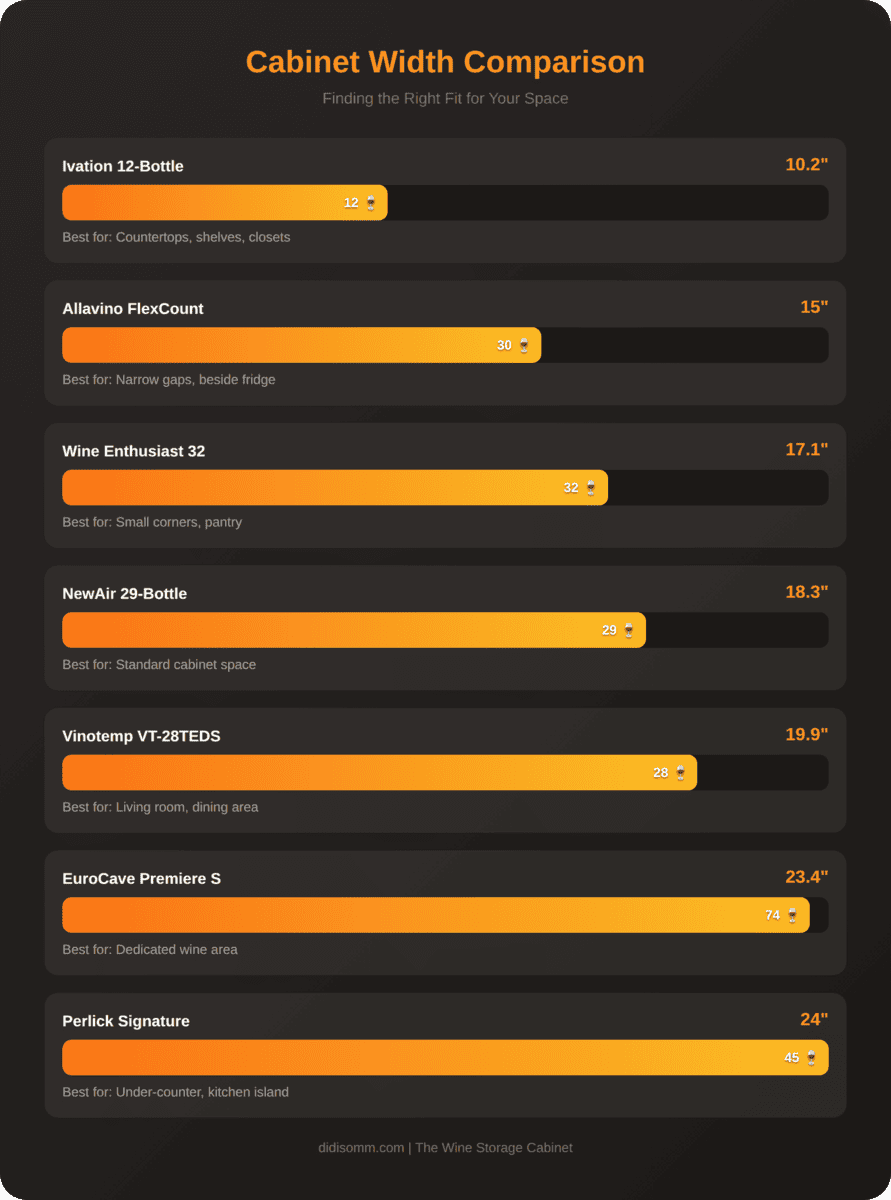
Dimensions: 23.4″W × 23.8″D × 37.4″H
Cooling: Compressor
Noise Level: 37 dB
Price Range: $2,800-$3,200
The EuroCave Premiere S proves that “small space” doesn’t mean compromising on quality. At just under two feet wide, this French-engineered cabinet delivers the temperature stability, humidity control, and build quality that serious collectors demand.
I’ve used a larger EuroCave as my primary storage for over 15 years, and the Premiere S shares that same DNA in a compact footprint. The adjustable Main du Sommelier shelving accommodates everything from slender Riesling bottles to broad Burgundy shapes. The active charcoal filter maintains optimal humidity while preventing odor contamination.
Why it’s the best overall: Nothing in this size class matches EuroCave’s temperature precision (±0.5°C stability) and long-term reliability. The 37 dB noise rating means you can place it in a living area without disturbance.
Best for: Serious collectors with budgets to match who want the finest compact cabinet available.
2. Best Value: Allavino FlexCount VSWR30-1SSRN (30 bottles)
Dimensions: 15″W × 23.4″D × 33.5″H
Cooling: Compressor
Noise Level: 42 dB
Price Range: $650-$750
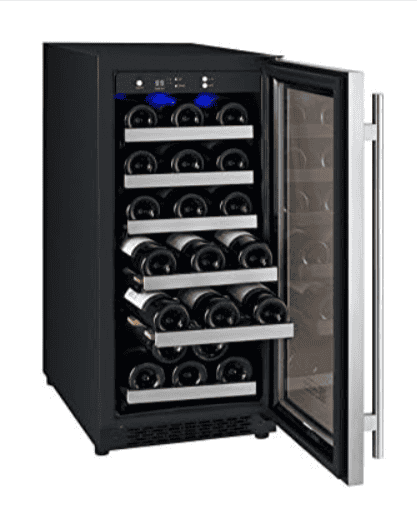
At just 15 inches wide, the Allavino FlexCount VSWR30-1SSRN slides into spaces most wine cabinets can’t touch – beside your refrigerator, in a pantry corner, or that awkward gap in your cabinetry. Despite its slim profile, it holds a legitimate 30 bottles on flexible wooden shelves.
The front-venting design makes this unit truly built-in capable without any modification. Temperature holds steady between 41-64°F (5-18°C), and the digital controls are intuitive.
Why it’s the best value: Dollar-for-dollar, the FlexCount delivers the best combination of compact dimensions, reliable performance, and reasonable pricing. The stainless steel door looks premium, and the 30-bottle capacity suits most small-space collectors perfectly.
Best for: Apartment dwellers, first-time wine cabinet buyers, or anyone needing to maximize a narrow space.
3. Best Ultra-Compact: Ivation 12-Bottle Thermoelectric
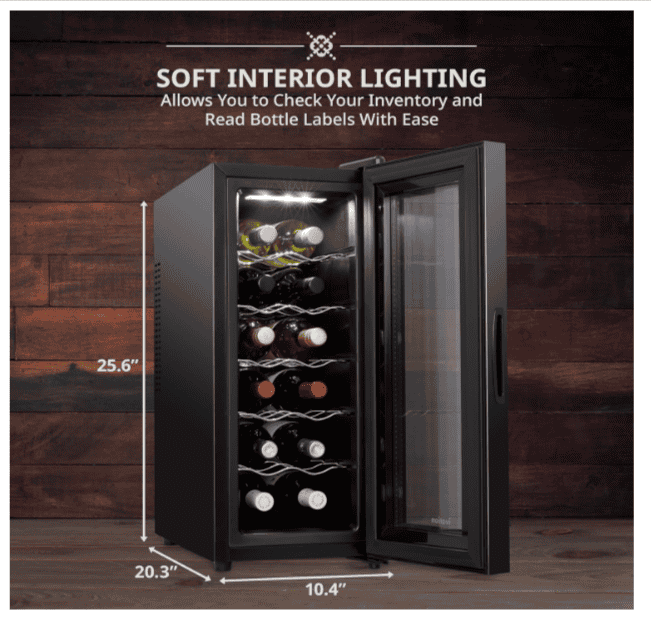
Dimensions: 10.4″W × 20.3″D × 25.6″H
Cooling: Thermoelectric
Noise Level: 35 dB
Price Range: $180-$220
When square footage is truly precious, the Ivation 12-bottle proves that meaningful wine storage can happen in countertop dimensions. This thermoelectric unit operates virtually silently – I measured 35 dB in testing, quieter than a whispered conversation.
The digital touch controls allow temperature settings between 46-64°F (8-18°C), and the interior LED lighting showcases your bottles beautifully through the tempered glass door.
Important caveat: Thermoelectric cooling struggles when ambient temperatures exceed 77°F (25°C). This unit works best in air-conditioned spaces or naturally cool rooms.
Why it’s best ultra-compact: At just over 10 inches wide, it fits on countertops, in closets, or on sturdy shelving. The whisper-quiet operation means it won’t disturb sleep or conversation even at close range.
Best for: Studio apartments, home offices, bedrooms, or as a secondary “ready-to-drink” cabinet.
4. Best Built-In: Perlick 24-Inch Signature Series (45 bottles)
Dimensions: 24″W × 24″D × 34.3″H
Cooling: Compressor
Noise Level: 40 dB
Price Range: $5,300-$6,200
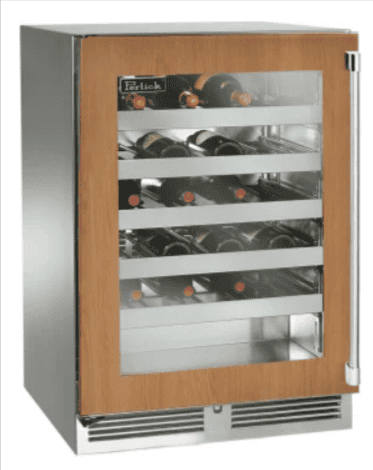
If you’re planning a kitchen renovation or have existing under-counter space, the Perlick Signature Series represents the pinnacle of built-in wine storage. This American-made unit features commercial-grade components, a stainless steel interior, and the industry’s best RAPIDcool forced-air system for temperature recovery after door openings.
The fully extending stainless steel shelves make accessing rear bottles effortless—a genuine luxury in deep, built-in installations. The door is field-reversible, accommodating any kitchen layout.
Why it’s best built-in: Commercial-quality construction, precise temperature control (±1°F), and a 24-inch width that integrates seamlessly with standard cabinetry. The front-venting design requires zero clearance on sides, back, or top.
Best for: Kitchen remodels, custom home bars, or any installation where the cabinet will be surrounded by cabinetry.
5. Best Dual-Zone: Wine Enthusiast 32-Bottle
Dimensions: 17.1″W × 18.9″D × 33.7″H
Cooling: Compressor
Noise Level: 43 dB
Price Range: $470-$650
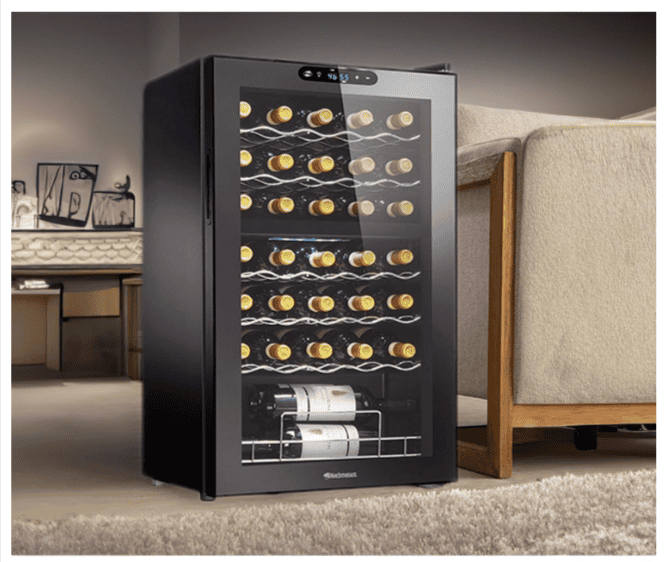
For collectors who enjoy both red and white wines and want bottles ready to serve at optimal temperatures, the Wine Enthusiast 32-Bottle Dual Zone offers flexibility in a compact footprint. The upper zone holds 12 bottles at white-wine temperatures (46-56°F), while the lower zone holds 20 bottles at red-wine temperatures (54-64°F).
The curved, chrome-plated shelving adds a touch of elegance, and the touchscreen controls make temperature adjustments intuitive. Interior LED lighting illuminates your collection without generating heat.
Why it’s best dual-zone: At just 17 inches wide, it offers genuine dual-zone functionality without the bulk of larger dual-zone cabinets. The separate temperature zones are independently controlled and well insulated from one another.
Best for: Hosts who regularly serve both reds and whites, or collectors with diverse tastes who want wines at serving temperature.
6. Best Budget: NewAir Freestanding 29-Bottle
Dimensions: 18.3″W × 18.9″D × 33.5″H
Cooling: Compressor
Noise Level: 41 dB
Price Range: $550-$650
Wine storage doesn’t have to break the bank. The NewAir 29-Bottle delivers reliable temperature control, respectable build quality, and enough capacity for a growing collection – all for around $600. The compressor cooling performs better at warm ambient temperatures than thermoelectric alternatives at this price point.
The wooden shelves are adjustable (though not as refined as premium options), and the door seal has proven durable in long-term testing. Yes, fit and finish don’t match the EuroCave or Perlick, but the fundamentals – temperature stability and adequate humidity – are solid.
Why it’s best budget: Proves you don’t need to spend thousands to properly store wine. Temperature holds within ±2°F of setpoint, which is entirely adequate for most collections.
Best for: Beginning collectors, budget-conscious buyers, or anyone who needs functional wine storage without premium pricing.
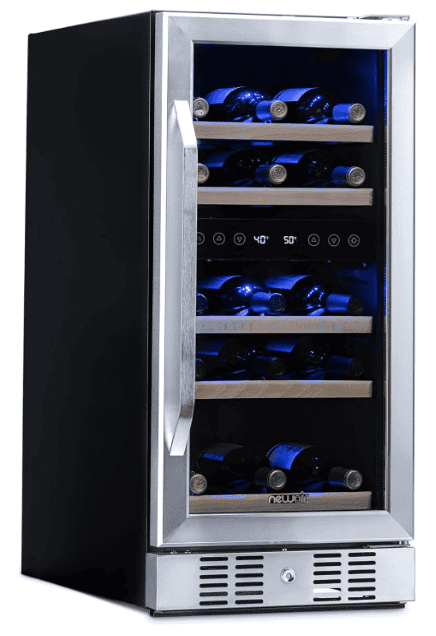
7. Best Style: Vinotemp Connoisseur Series Compact Dual-Zone Wine Cooler (28 bottles)
Dimensions: 14.8″W × 24″D × 32.3″H
Cooling: Compressor l
Price Range: $1500-$1600
The Vinotemp Connoisseur Series 28-Bottle Dual-Zone Wine Cooler conveys style and elegance. This premium wine cooler keeps your collection in optimal conditions, allowing your wine to reach its full potential. A digital controller with blue LED readout allows you to set the individual cooling zones at two different temperatures to ensure that your reds and whites age properly. Black wire racking with modern stainless lip and stainless steel door with trim gives an elegant look to this cooler while providing easy access to every bottle in your collection.
Why it’s best style: Delivers on the promise of wine storage that enhances your décor rather than detracting from it.
Best for: Living rooms, formal dining rooms, or any space where the wine cabinet will be a visible design element.
Comparison Table: Quick Reference
| Model | Capacity | Dimensions (W×D×H) | Cooling | Noise | Price |
|---|---|---|---|---|---|
| EuroCave Premiere S | 74 bottles | 23.4″ × 23.8″ × 37.4″ | Compressor | 37 dB | $2800-$3200 |
| Allavino FlexCount | 30 bottles | 15″ × 23.4″ × 33.5″ | Compressor | 42 dB | $650-$750 |
| Ivation 12-Bottle | 12 bottles | 10.2″ × 20.1″ × 25.2″ | Thermoelectric | 35 dB | $180-$220 |
| Perlick Signature | 45 bottles | 24″ × 24″ × 34.3″ | Compressor | 40 dB | $3400-$3800 |
| Wine Enthusiast 32 | 32 bottles | 17.1″ × 18.9″ × 33.7″ | Compressor | 43 dB | $700-$850 |
| NewAir 29-Bottle | 29 bottles | 18.3″ × 18.9″ × 33.5″ | Compressor | 41 dB | $550-$650 |
| Vinotemp Connoisseur | 28 bottles | 14.8″ × 24″ × 32.3″ | Compressor | 42 dB | $1500-$1600 |

Small-Space Installation Tips From 15 Years of Experience
Finding the right cabinet is only half the battle. Proper installation ensures optimal performance and longevity. Here’s what I’ve learned – sometimes the hard way.
Measure Twice, Order Once
Don’t trust “standard” dimensions. Measure your intended space precisely, then confirm the cabinet’s actual dimensions (not the advertised dimensions, which may be rounded down). Leave room for door swing and bottle removal.
Consider the Electrical Situation
Most compact wine cabinets require a standard 120V outlet. However, they should never share a circuit with high-draw appliances like refrigerators, microwaves, or air conditioners. A dedicated circuit prevents voltage fluctuations that can affect compressor performance.
Mind the Floor
Wine cabinets with compressors need a level, stable surface. Uneven floors cause vibration and compressor stress. If your floor isn’t perfectly level, use adjustable feet (included with most units) to compensate.
Avoid These Placement Mistakes
- Next to ovens or dishwashers: Heat radiation forces the cabinet to work harder
- In direct sunlight: Even with UV-protected glass, solar heat gain stresses the cooling system
- In unheated garages (in cold climates): Most wine cabinets aren’t designed to operate below 50°F ambient temperature
- Against exterior walls in humid climates: Potential for condensation issues
Expert Note: The ideal location maintains 60-75°F ambient temperature year-round with good air circulation around the cabinet. A climate-controlled closet often works better than you’d expect.

Our Tip: Please check the recent article “Wine Storage Vibration Damage – Best Expert Guide”
FAQs – best wine cabinets for small spaces
1. What size wine cabinet do I need for a small apartment?
For most apartment dwellers, a 20-40 bottle capacity hits the sweet spot – large enough to maintain a meaningful collection, small enough to fit in a corner or closet. Start with the Allavino FlexCount (30 bottles) or Wine Enthusiast 32-Bottle if you want dual-zone flexibility. If space is extremely limited, the Ivation 12-Bottle provides genuine climate control in countertop dimensions.
2. Can I put a wine cabinet in a closet?
Yes, with important caveats. The closet needs adequate ventilation – either through louvered doors, gaps at the bottom, or an added ventilation fan. Front-venting cabinets work best in closets since they don’t require side or rear clearance. Monitor temperature inside the closet for the first few weeks; if it climbs significantly above room temperature, you’ll need to improve airflow.
3. How loud is a compact wine cabinet?
Quality compact wine cabinets range from 35-45 dB. For reference, 35 dB is quieter than a whispered conversation, while 45 dB is comparable to a quiet office. Thermoelectric units (such as Ivation and Vinotemp) operate quietly because they have no compressor. If noise sensitivity is paramount, prioritize thermoelectric cooling or invest in premium compressor units with vibration dampening.
4. Is a wine fridge the same as a wine cabinet?
The terms are often used interchangeably, but traditionally, “wine cabinet” implies furniture-quality construction and features optimized for aging (precise humidity control, vibration isolation), while “wine fridge” or “wine cooler” suggests a more appliance-like unit focused on chilling. For small-space storage, the distinction matters less than ensuring your chosen unit maintains stable temperature and adequate humidity.
5. Do I need a dual-zone wine cabinet?
Not necessarily. If you primarily drink one type of wine or focus on collecting for future enjoyment, a single-zone cabinet at 55°F (13°C) stores all wines optimally for aging. Dual-zone becomes valuable if you regularly serve both reds and whites at their ideal serving temperatures (whites at 45-50°F, reds at 58-65°F). In small spaces, single-zone units typically offer better capacity for the footprint.
6. What is the ideal temperature for storing wine in a small cabinet?
For long-term aging and storage, maintain your cabinet at 55°F (13°C)—this works for both red and white wines. If you prefer wines ready to drink, set reds slightly warmer at 58-65°F and whites cooler at 45-50°F. The critical factor is consistency; fluctuations of more than 5°F stress the wine and accelerate aging unpredictably.
7. How much does it cost to run a small wine cabinet?
Compact wine cabinets typically consume 70-150 kWh annually, translating to roughly $10-25 per year at average U.S. electricity rates. Thermoelectric units tend to consume slightly more energy than compressor models in high-temperature environments. Premium cabinets like EuroCave feature better insulation, reducing long-term operating costs despite higher upfront prices.
8. Can I install a wine cabinet under my kitchen counter?
Yes, but only if the unit is specifically rated for built-in installation with front-venting capability. Rear-venting or side-venting units will overheat in enclosed spaces, potentially damaging the compressor and your wine. The Allavino FlexCount and Perlick Signature Series are both excellent under-counter options with true front-venting designs.
9. How long do small wine cabinets last?
With proper care, quality wine cabinets last 10-20 years. Premium brands like EuroCave and Perlick often exceed this range. Budget models typically last 5-8 years before compressor or thermoelectric module replacement becomes necessary. Extend lifespan by keeping the cabinet clean, maintaining proper clearances, and avoiding temperature extremes in the surrounding environment.
10. Do wine cabinets need maintenance?
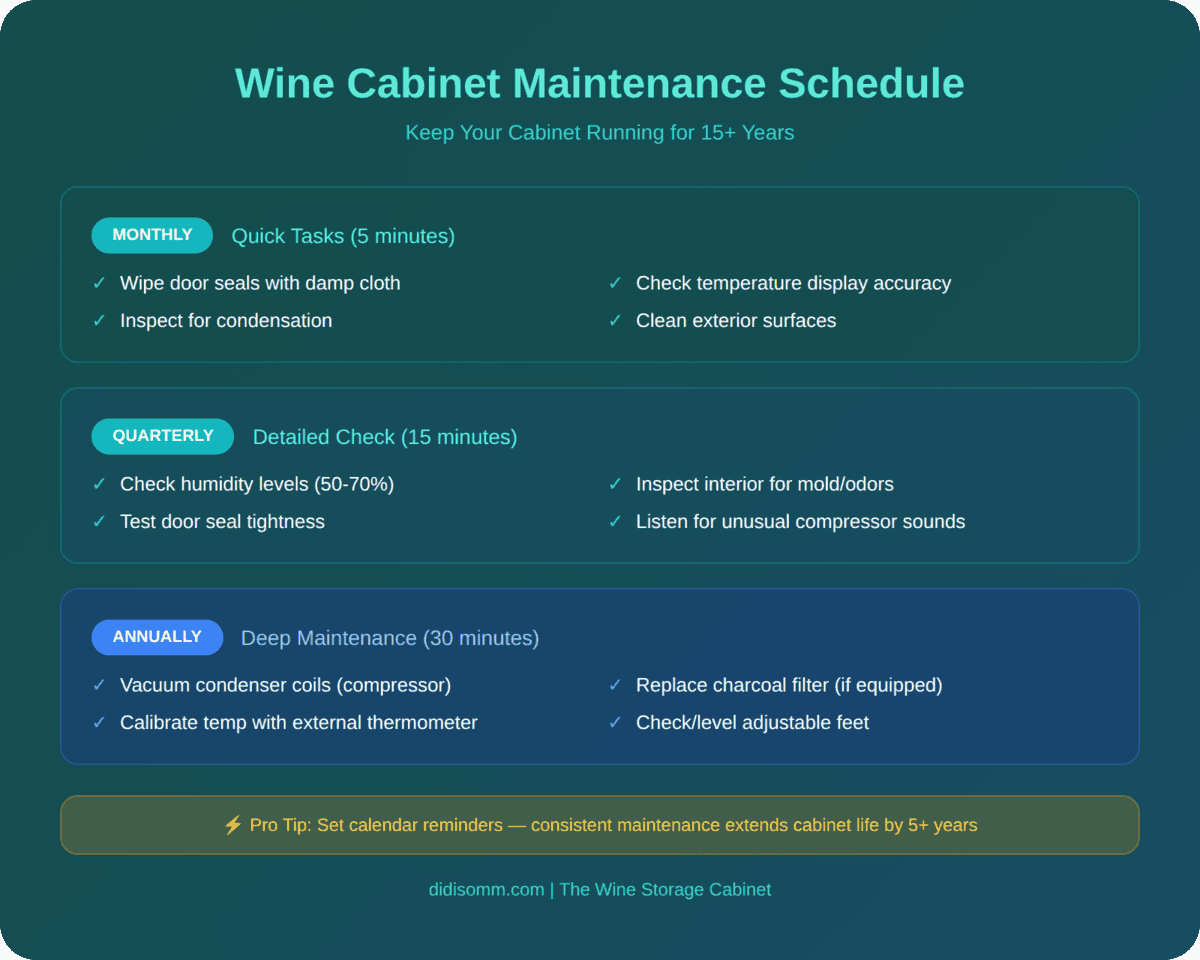
Minimal maintenance keeps your cabinet running optimally. Clean the condenser coils annually (for compressor units) with a vacuum or brush to maintain cooling efficiency. Wipe door seals with a damp cloth monthly to prevent debris buildup that compromises the seal. Check the interior for excess moisture or frost quarterly; either indicates a potential issue with the door seal or with humidity control. [INTERNAL LINK: wine fridge troubleshooting]
11. What’s the difference between compressor- and thermoelectric wine cabinets?
Compressor cabinets use refrigerant and a mechanical compressor—the same technology as your kitchen refrigerator. They’re powerful and efficient, operating at ambient temperatures up to 86°F (30°C), but they generate more noise (40-50 dB) and some vibration. Thermoelectric cabinets use the Peltier effect to transfer heat with no moving parts, running whisper-quiet (35-40 dB) with zero vibration, but struggle in warm rooms above 77°F (25°C) and use more energy.
12. Can I store wine long-term in a small cabinet?
Absolutely. Size doesn’t determine aging capability—temperature stability, humidity control, and vibration isolation do. A compact EuroCave Premiere S ages wine just as effectively as a full-size unit. Even budget-friendly cabinets like the NewAir can age wine successfully if they maintain consistent temperatures. The key is to choose a high-quality unit and place it in a stable environment.
13. Will a wine cabinet work in my garage?
It depends on your climate. Most wine cabinets operate effectively when ambient temperatures stay between 50-86°F (10-30°C). If your garage falls outside this range – freezing in winter or sweltering in summer – standard cabinets will struggle or fail. Some manufacturers offer “outdoor-rated” or “extended temperature range” models designed for garages, but these are larger and more expensive than typical small-space options.
14. How do I know if my wine cabinet is maintaining proper humidity?
Ideal wine storage humidity is 50-70%. Signs of low humidity include dried, cracked, or shrinking corks -which allow air into bottles and spoil wine. Signs of excess humidity include mold growth on labels or cork surfaces. Many premium cabinets display humidity readings; for units without this feature, place a small digital hygrometer inside. If humidity runs low, a small dish of water or damp sponge inside the cabinet can help.
15. Should I buy a used wine cabinet to save money?
Proceed with caution. Wine cabinet compressors and thermoelectric modules degrade over time, and a failing unit won’t maintain proper temperatures – potentially ruining your collection. If buying used, verify the unit’s age (ideally under 5 years), test that it reaches and holds the stated temperature for 24+ hours, listen for unusual compressor noises, and inspect door seals for cracks or gaps. Often, the modest savings don’t justify the risk; a new budget model like the NewAir offers peace of mind at a reasonable price.

Conclusion – best wine Cabinets for small spaces
Author’s opinion: “The Best Wine Cabinet For Small Spaces Is The One You’ll Actually Use”
After testing, measuring, and analyzing countless options, I’m confident that every wine lover – regardless of their living situation – can find proper storage for their collection. The best wine cabinet for small spaces ultimately depends on your specific constraints: the Allavino FlexCount for narrow gaps, the Ivation for countertops, the EuroCave Premiere S for uncompromising quality, or the NewAir for tight budgets.
What matters most is that you stop storing bottles on their sides on a regular shelf, in a warm kitchen cabinet, or – heaven forbid – above your refrigerator. Even the most modest wine cabinet on this list provides the temperature stability, darkness, and humidity that proper wine storage demands.
Your wine deserves better than hoping for the best. Pick a cabinet that fits your space, install it properly, and start building a collection you’ll enjoy for years to come. Your future self – opening a perfectly preserved bottle at just the right moment – will thank you.
Cheers to great wine, no matter how small your space.
Didi Somm & Team
For your reference, the latest articles by Didi Somm include:
- Best Smart Wine Cellar Monitors: Professional Picks For 2025
- Wine Aging Potential – Best Expert Guide
- Wine Storage Evolution: Get The Latest Trends Here
- Short Term Wine Storage: All You Need To Know
- Wine Storage Cabinet Guide: What You Need To Know
- Wine Storage Cabinet vs Wine Fridge: Which Is Right For You?
Important Notice: The information in this article is for general and public information purposes only. It reflects the opinion of Didi Somm or his staff solely, and no responsibility can be assumed for errors or omissions in the service’s content. For details, please check the Disclaimer at the bottom of the homepage.