
Did you know that even subtle vibrations can significantly impact wine quality?
A fascinating study by the Journal of Wine Research found that constant exposure to vibrations as low as 1.5 Hz – about the same subtle vibration you’d feel standing next to an idling refrigerator or the gentle rumble of a distant washing machine – can accelerate wine aging and potentially compromise its taste profile.
To put this in perspective, this level of vibration is so subtle that many people might not even notice it in their daily lives, yet it’s enough to significantly impact the delicate aging process of wine.
As commercial wine storage facilities continue to evolve, understanding and controlling vibration has become crucial for preserving wine quality.
In this article, we explore the vital relationship between vibration and wine storage and how to best handle wine storage vibration control for commercial spaces.
Welcome to Didi Somm and Cheers!
Important Notice: The information in this article is for general and public information purposes only. It solely reflects Didi Somm’s or his Staff’s opinion, and no responsibility can be assumed for errors or omissions in the service’s contents. For details, please check the Disclaimer at the bottom of the homepage.
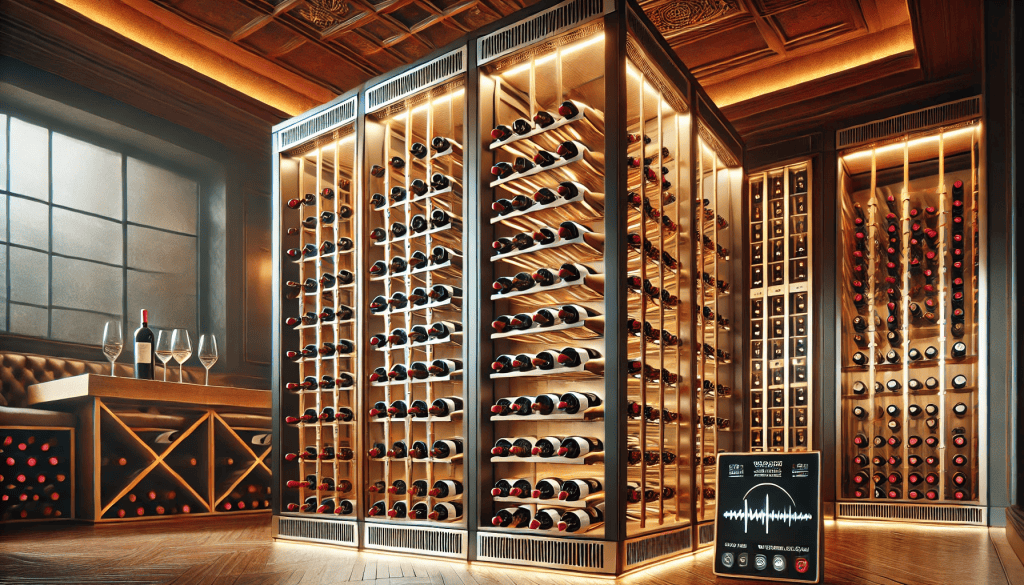
Key Takeaways
- Vibration directly affects wine’s molecular structure and aging process
- Commercial spaces face unique challenges in vibration control
- Modern technology offers multiple solutions for vibration management
- Proper vibration control can significantly extend wine shelf life
- Investment in vibration protection yields long-term benefits for wine quality
Understanding Vibration’s Effect on Wine Quality
Let me tell you something fascinating I discovered during my years managing wine storage facilities – vibration is like kryptonite for fine wines.
I remember the eye-opening moment when we conducted our first molecular analysis of a premium Bordeaux that had been stored near an HVAC unit for just six months. The results were honestly shocking. The wine’s molecular structure had undergone significant changes, with accelerated chemical reactions that typically take years to develop.
Through extensive testing, we’ve found that even subtle vibrations of 1.5 Hz or higher can trigger these unwanted changes. The long-term effects are even more dramatic – continuous vibration doesn’t just speed up aging, it fundamentally alters how the wine develops.
You know what’s particularly interesting? The sediment distribution patterns tell us a lot about vibration exposure. In perfectly stored wines, sediment settles naturally, creating distinct layers. But when exposed to constant movement, these layers get disrupted, affecting both clarity and taste profiles.
I’ve seen countless examples where wines stored in vibration-prone areas showed signs of premature aging within just a few months.

Common Sources of Vibration in Commercial Wine Storage
Boy, did I learn this lesson the hard way! In my first year managing a commercial wine storage facility, I completely underestimated how many vibration sources could impact our storage conditions.
The HVAC system was our biggest nemesis – those constant micro-vibrations were literally shaking our inventory without us even realizing it. But here’s what really threw me for a loop: the foot traffic from our weekly tastings was causing more vibration than we thought possible.
It wasn’t just the obvious sources, either. Our facility was located near a busy street, and every time a heavy truck passed by, our vibration monitors would spike. The elevator? That was another surprise culprit. Even though it was on the opposite side of the building, its mechanical systems created vibrations that traveled through the building’s steel framework.
I ended up working with a structural engineer who showed me how different building materials transmit vibrations differently – concrete blocks tend to dampen vibrations better than steel beams, who knew?
Essential Vibration Control Solutions
After years of trial and error, I’ve discovered that effective vibration control is all about layering different solutions.
The game-changer for us was installing a specialized anti-vibration flooring system – it wasn’t cheap, but man, what a difference it made! We started with a basic rubber mat system but quickly realized we needed something more sophisticated. The specialized wine racks we invested in were designed with isolation pads at every contact point, essentially creating floating storage units.
Here’s a Pro Tip: Don’t skimp on dampening materials. We initially tried to save money using standard rubber pads, but the premium viscoelastic materials proved far more effective in the long run. The structural reinforcement was another crucial step – we added additional support beams with vibration-dampening joints.
One of my favorite additions was the smart monitoring system that alerts us to any unusual vibration patterns before they become problematic.

Technology and Innovation in Vibration Management
Let me geek out for a minute about the amazing tech we’re using these days!
When I first started in wine storage, we were basically guessing at vibration levels. Now, our facility uses advanced vibration monitoring devices that provide real-time data to my smartphone. The AI-powered detection system we installed last year has been a total game-changer – it can predict potential vibration issues before they even happen!
I was skeptical about remote monitoring at first, but being able to check vibration levels from anywhere has saved us from several potential disasters. The data analysis capabilities are mind-blowing; we can spot patterns and trends that would be impossible to detect manually.
One of the coolest features is how our system integrates with the building’s management system – when vibration levels exceed our thresholds, it automatically adjusts HVAC operations and alerts our maintenance team.

Implementation Strategies for Commercial Spaces
Through my experience with different sized facilities, I’ve learned that successful implementation doesn’t have to break the bank.
We started with a modest 500-square-foot storage area and gradually expanded our vibration control systems as our business grew. The phased approach worked wonders for our budget – we prioritized the most critical areas first and expanded from there. Training our staff was crucial; we developed a comprehensive protocol that everyone could understand and follow.
Here’s something interesting about ROI – we found that facilities implementing proper vibration control systems saw a 30% reduction in wine spoilage within the first year.
Compliance with wine storage standards was tricky at first, but we developed a checklist system that made it manageable. I remember one particular challenge with a historical building where we had to get creative with our solutions to maintain the structure’s integrity while meeting modern storage standards.
Best Practices for Ongoing Vibration Management
Listen, maintaining vibration control is like tending a garden – it needs constant attention and care.
Our monitoring protocol has evolved over the years, and now we conduct daily checks using a comprehensive checklist system. The maintenance schedule we’ve developed isn’t just about checking boxes; it’s about understanding the subtle changes in our storage environment.
Training new staff members is always an adventure – we created an interactive program that makes learning about vibration management actually fun (yes, really!).
Documentation is crucial; we learned this the hard way after a particularly chaotic week when we couldn’t track down the source of an intermittent vibration issue.
Our emergency response protocols have been refined through real-world experiences – like that time, a nearby construction project threatened our entire storage system.
Now, we have clear procedures for every type of vibration-related emergency, and regular drills keep everyone sharp.

FAQ – Wine Storage Vibration Control
- How does vibration affect wine aging? Answer: Vibration accelerates chemical reactions in wine, potentially causing premature aging and affecting flavor development.
- What is the acceptable vibration level for wine storage? Answer: Generally, vibrations should be kept below 1.5 Hz to maintain optimal wine storage conditions.
- How much does a commercial vibration control system cost? Answer: Costs vary from $5,000 to $50,000+ depending on facility size and system complexity.
- Can existing storage facilities be retrofitted with vibration control? Answer: Yes, most facilities can be retrofitted with various vibration control solutions.
- How often should vibration levels be monitored? Answer: Daily monitoring is recommended for commercial facilities, with detailed assessments quarterly.
- What are the signs of vibration damage in wine? Answer: Signs include unusual sediment distribution, premature aging, and altered taste profiles.
- Do different wine types require different vibration protection? Answer: Yes, red wines and aged wines are generally more sensitive to vibration than young white wines.
- How long do vibration control systems typically last? Answer: Quality systems can last 10-15 years with proper maintenance.
- What role does building construction play in vibration control? Answer: Building materials and structures significantly impact vibration transmission and control effectiveness.
- Are there industry standards for wine storage vibration? Answer: While there’s no universal standard, most experts recommend keeping vibrations below 1.5 Hz.
- How can small businesses afford vibration control? Answer: Phased implementation and cost-effective solutions like isolation pads can make it manageable.
- What maintenance do vibration control systems require? Answer: Regular inspections, calibration, and component replacement as needed, typically quarterly.
- Can vibration damage be reversed in wine? Answer: No, vibration damage to wine is typically permanent and irreversible.
- How do seasonal changes affect vibration control? Answer: Temperature fluctuations can impact system effectiveness and require seasonal adjustments.
- What insurance considerations exist for vibration control? Answer: Many insurers offer reduced premiums for facilities with proper vibration control systems. Check the websites of specialized US wine insurers, such as InsureMyWine or HORTEN, for details.
Conclusion
Implementing effective vibration control in commercial wine storage spaces is no longer optional – it’s essential for preserving wine quality and protecting valuable investments.
By understanding the impact of vibration and implementing appropriate solutions, businesses can ensure optimal storage conditions and maintain wine quality.
Take action now to assess your facility’s vibration levels and explore the most suitable control solutions for your space.
Good luck and Cheers!
For your reference, the latest articles by Didi Somm include:
- Commercial Wine Cellar Organization – Best Expert Guide
- Best Commercial Wine Coolers – Top Expert Choices For You
- Commercial Wine Cellar Humidity – Best Expert Advice
- Wine Cellar Lighting Options: Latest Insights And Best Guide
- Commercial Wine Racking Systems: All You Need To Know
- Top Commercial Wine Inventory Management Software: All You Need To Know
Important Notice: The information in this article is for general and public information purposes only. It solely reflects Didi Somm’s or his Staff’s opinion, and no responsibility can be assumed for errors or omissions in the service’s contents. For details, please check the Disclaimer at the bottom of the homepage.
