
Did you know that proper wine storage can increase wine sales by up to 20% in restaurants?
As a restaurant owner or sommelier, investing in the right commercial wine cooler isn’t just about storage – it’s about elevating your wine service and protecting your investment.
In this comprehensive guide, I’ll walk you through the best commercial wine coolers that combine optimal storage conditions, reliability, and style to enhance your restaurant’s wine program.
Welcome to Didi Somm, and Cheers!
Important Notice: The information in this article is for general and public information purposes only. It solely reflects Didi Somm’s or his Staff’s opinion, and no responsibility can be assumed for errors or omissions in the service’s contents. For details, please check the Disclaimer at the bottom of the homepage.

Key Takeaways
- Dual-zone temperature control is essential for storing different wine varieties
- Commercial-grade units offer superior durability and temperature stability
- Energy efficiency impacts long-term operational costs
- Proper sizing based on bottle capacity and space requirements is crucial
- UV protection and humidity control preserve wine quality
- Regular maintenance extends cooler lifespan and performance
Understanding Commercial Wine Cooler Requirements
Let me tell you, learning the differences between residential and commercial wine coolers was an eye-opener when I first started consulting for restaurants.
Commercial units are absolute workhorses compared to their residential cousins. I remember walking into a high-end steakhouse that had tried to save money by installing residential units – big mistake! Their wine constantly fluctuated in temperature because the coolers couldn’t handle frequent door openings.
Commercial wine coolers are built differently, with robust compressors that maintain temperature stability even during peak service hours. The recovery rate is crucial – you need a unit that can bounce back to the proper temperature within minutes after the door’s been opened twenty times during dinner service.
Health department requirements are another critical factor that many restaurant owners overlook. Most jurisdictions require commercial-grade equipment with NSF certification, and you’ll need to maintain specific temperature logs.
For capacity planning, I always recommend calculating your max inventory and then adding 30% for growth and seasonal fluctuations. Trust me, you’ll thank me during the holiday rush when wine sales spike!

Affiliate Disclaimer: This page may include Affiliate links, meaning that we get a commission if you decide to purchase through this site at no extra cost to you. Please read our Disclaimer for your info.
Top Commercial Wine Coolers Comparison
After testing dozens of commercial wine coolers over the years, I’ve developed a pretty solid framework for comparison. Below, I will briefly introduce some of my top choices – please check individual websites for detailed information.
The EuroCave Professional 4000 Series has been my go-to recommendation for mid-sized restaurants, offering an impressive capacity of up to 230 bottles. It provides optimal conditions for storing, aging, and servicing red, white, and sparkling wines and is available as a single- or multi-zone wine cellar.

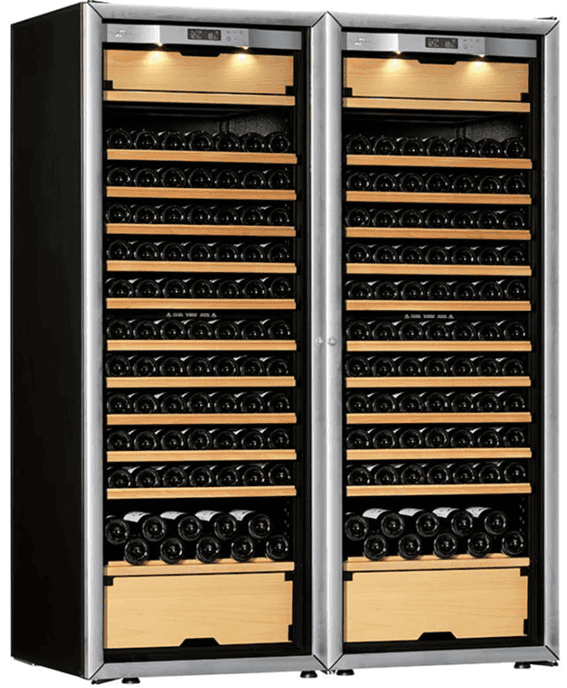
For larger operations, the Transtherm Double Castel Glass Brushed Aluminum Full Shelf offers a capacity between 330 to 418 bottles and three temperature zones for storing red wines and cooling white- and sparkling wines.
Energy efficiency is a major consideration – the newest models from True Manufacturing feature improved insulation and Energy Star ratings, potentially saving hundreds in annual operating costs.

Price Range
Speaking of costs, expect to invest between $3,000 for entry-level commercial units up to $15,000 for premium models. The sweet spot for most restaurants is around $5,000-7,000, which typically gets you excellent build quality and essential features without breaking the bank.
Features That Matter Most
Through years of helping restaurants set up their wine programs, I’ve learned which features truly make a difference in day-to-day operations.
Temperature Control
Temperature control is non-negotiable – you need a system with precise digital controls and multiple temperature zones. I once worked with a client who lost thousands in inventory because their single-zone cooler malfunctioned. Now, I always recommend redundant temperature sensors and alarm systems.
Humidity Management
Humidity management is equally crucial – aim for units with active humidity control that maintain 60-70% relative humidity.
Vibration Reduction
Vibration reduction might seem like a luxury, but it’s essential for long-term storage. Modern compressor mounting systems and vibration-dampening shelves make a huge difference in wine preservation.
UV Protection
UV protection is another must-have; LED lighting looks great and doesn’t generate heat or harmful UV rays.
Security
For security, look for units with tamper-proof controls and lockable doors – unfortunately, I’ve seen too many cases of inventory “shrinkage” that could have been prevented.
Installation and Space Planning
Let’s talk about one of the most overlooked aspects of commercial wine cooler selection – proper installation and space planning.
I learned this lesson the hard way when I helped a client install a beautiful built-in unit, only to discover the heat couldn’t dissipate properly due to insufficient ventilation. Now, I always ensure there’s at least 4 inches of clearance around the unit for proper airflow.
Power requirements are another crucial consideration – most commercial units need dedicated 20-amp circuits, and some larger models require 220V power.
Location selection is critical; avoid placing units near heat-generating appliances or in direct sunlight.
The choice between built-in and freestanding models depends largely on your space constraints and aesthetic goals. While built-ins offer a sleek, integrated look, freestanding units provide more flexibility for future layout changes.
Always hire a professional for installation – the cost is worth avoiding potential issues with ventilation, power supply, and warranty coverage.

Maintenance and Longevity
Having overseen maintenance for numerous restaurant wine programs, I can’t stress enough how proper care extends the life of your investment.
Maintenance Schedule
Establish a regular maintenance schedule – monthly cleaning of condenser coils, weekly inspection of door seals, and daily temperature monitoring are absolute musts. The most common issues I’ve encountered are related to poor maintenance: clogged condensers, worn door gaskets, and calibration drift.
Warranty
A solid warranty is crucial; look for coverage that includes both parts and labor for at least 2-3 years.
Cleaning
For cleaning, use only non-abrasive cleaners on the interior and exterior surfaces.
Professional Service Checks
I recommend scheduling professional service checks twice annually – it’s much cheaper than emergency repairs during peak service hours. One restaurant I worked with skipped regular maintenance and ended up replacing their unit after just three years.
Longevity
Properly maintained, a quality commercial wine cooler should last 10-15 years.
Maximizing Your Investment
After spending years optimizing wine storage systems for restaurants, I’ve discovered some game-changing strategies for maximizing ROI.
Energy efficiency starts with smart loading practices – maintain proper spacing between bottles and avoid blocking air circulation vents.
Installing a digital temperature monitoring system might seem like an unnecessary expense, but it’s saved multiple clients from catastrophic inventory losses by alerting them to problems before they become critical.
Staff training is absolutely essential – I develop simple checklists for daily operations and maintenance procedures. Teach your team the proper way to handle inventory rotation and how to spot potential issues early.
Calculate your ROI by tracking energy costs, maintenance expenses, and wine preservation rates. One client reduced their wine spoilage by 85% after implementing these practices, resulting in thousands in annual savings.
Remember, a well-maintained wine cooler isn’t just about storage – it’s about protecting your investment and enhancing your wine service program.

FAQ – Best Commercial Wine Coolers
- What size commercial wine cooler do I need for my restaurant? Answer: Calculate your maximum inventory plus 20% growth capacity. Generally, a 100-seat restaurant needs storage for 200-300 bottles minimum.
- How much do commercial wine coolers cost? Answer: Commercial wine coolers range from $2,000 to $15,000, depending on capacity and features.
- What’s the difference between commercial and residential wine coolers? Answer: Commercial units offer stronger cooling systems, better temperature recovery, and are built for frequent access and higher usage.
- Should I choose a single or dual-zone wine cooler? Answer: Dual-zone coolers are recommended for restaurants serving both red and white wines at their optimal temperatures.
- What temperature ranges are important for commercial wine storage? Answer: Red wines need 55-65°F, white wines 45-55°F, and sparkling wines 40-45°F.
- How long do commercial wine coolers typically last? Answer: With proper maintenance, commercial wine coolers can last 10-15 years.
- What maintenance is required for commercial wine coolers? Answer: Regular cleaning, condenser maintenance, seal inspection, and temperature monitoring are essential.
- Are commercial wine coolers energy efficient? Answer: Modern units are increasingly efficient, with Energy Star ratings available on many models.
- What warranty should I look for? Answer: Look for minimum 2-3 year parts and labor coverage, with extended options available.
- Can I install a commercial wine cooler myself? Answer: Professional installation is recommended to ensure proper ventilation and electrical requirements are met.
- How important is humidity control? Answer: Critical – ideal humidity should be maintained between 60-70% to prevent cork damage.
- What security features should I consider? Answer: Look for lockable doors, inventory tracking systems, and tamper-proof controls.
- How often should temperature be monitored? Answer: Daily monitoring is recommended, with automated systems providing continuous oversight.
- What’s the ideal location for a commercial wine cooler? Answer: Away from heat sources, direct sunlight, and high-traffic areas that could cause vibration.
- How can I maximize energy efficiency? Answer: Regular maintenance, proper loading, minimizing door openings, and maintaining ambient temperature control.
Conclusion
Investing in the right commercial wine cooler is crucial for any restaurant serious about its wine program. By considering factors like capacity, temperature control, and long-term maintenance, you can select a unit that not only preserves your wine investment but also enhances your restaurant’s wine service.
Remember, the best commercial wine cooler is one that meets your specific needs while providing reliable, efficient service for years to come.
Wishing you good luck with finding the perfect commercial wine cooler. Cheers!
For your reference, the latest articles by Didi Somm include:
- DIY Wine Carriers: 7 Creative Ideas That Surprise You
- Most Durable Wine Travel Accessories – Best Expert Guide For You
- Guide to Commercial Wine Storage: Best Expert Insights
- Retail Wine Storage Solutions: Best Expert Advice
- Wine Locker Storage Explained. Best Expert Guide For You
- Commercial Wine Cellar Organization – Best Expert Guide
Important Notice: The information in this article is for general and public information purposes only. It solely reflects Didi Somm’s or his Staff’s opinion, and no responsibility can be assumed for errors or omissions in the service’s contents. For details, please check the Disclaimer at the bottom of the homepage.

