Most wine fridge buyers spend hours comparing bottle capacity and temperature zones — then completely ignore the one number that follows them every single month for the next decade: the wine fridge energy cost. A wine fridge runs 24 hours a day, 365 days a year. That quiet hum in the corner of your kitchen is metered and charged, every single day, whether you open the door or not.
The good news is that modern wine fridges are far more efficient than they were five years ago. The less good news is that the difference between a well-chosen model and a poorly chosen one can easily run to $50–$80 per year in wasted electricity — and over a ten-year lifespan, that gap compounds into real money. This guide gives you the actual 2026 numbers, explains what drives them, and tells you exactly what to look for before you buy.
Welcome to Didi Somm & Team
Important Notice: The information in this article is for general and public information purposes only. It reflects the opinion of Didi Somm or his staff solely, and no responsibility can be assumed for errors or omissions in the service’s content. For details, please check the Disclaimer at the bottom of the homepage.
Key Takeaways — Wine Fridge Energy Costs 2026
- A mid-size wine fridge costs $29–$80 per year to run — less than most people assume
- Placement and door seal condition affect running costs more than brand or price
- Inverter compressor models run 15–25% more efficiently than standard compressors
- Thermoelectric units are only efficient in rooms below 77°F (25°C) — compressor wins in warm climates
- Setting your fridge to 55°F instead of colder is the single easiest free efficiency gain
- The annual kWh figure in the specs — not the wattage — is the number to compare when shopping
How a wine fridge uses electricity
Wine fridges maintain a stable temperature — typically 53–57°F (12–14°C) for long-term storage — regardless of the ambient temperature around them. The harder the compressor or thermoelectric system has to work to hold that gap, the more electricity it consumes. Three variables drive almost everything:
First, the cooling technology. Compressor-based wine fridges are more powerful and better at maintaining temperature in warm rooms, but they cycle on and off, drawing higher current spikes. Thermoelectric models run more quietly and with less vibration, but they struggle in rooms above 77°F (25°C) and may draw power continuously to compensate. In most climates and typical home environments, a quality compressor unit at the same capacity will run more efficiently overall.
Second, the capacity and insulation. A 12-bottle thermoelectric unit and a 100-bottle dual-zone compressor fridge are not comparable. Larger units generally cost more to run in absolute terms, but better-insulated cabinets — look for dual-pane glass doors and tight magnetic seals — hold temperature more efficiently and reduce compressor cycling.
Third, placement. A wine fridge pushed against a wall with no side clearance, placed next to an oven, or sitting in a garage that hits 95°F in summer will work dramatically harder than the same unit in a cool, ventilated spot. Placement is free to fix and has a larger impact than most buyers realize.
What wine fridges actually cost to run in 2026
Rather than quoting manufacturer specifications — which are tested under ideal lab conditions — here are realistic annual running cost ranges based on typical US electricity rates of approximately $0.16 per kWh in 2026 and real-world usage patterns:
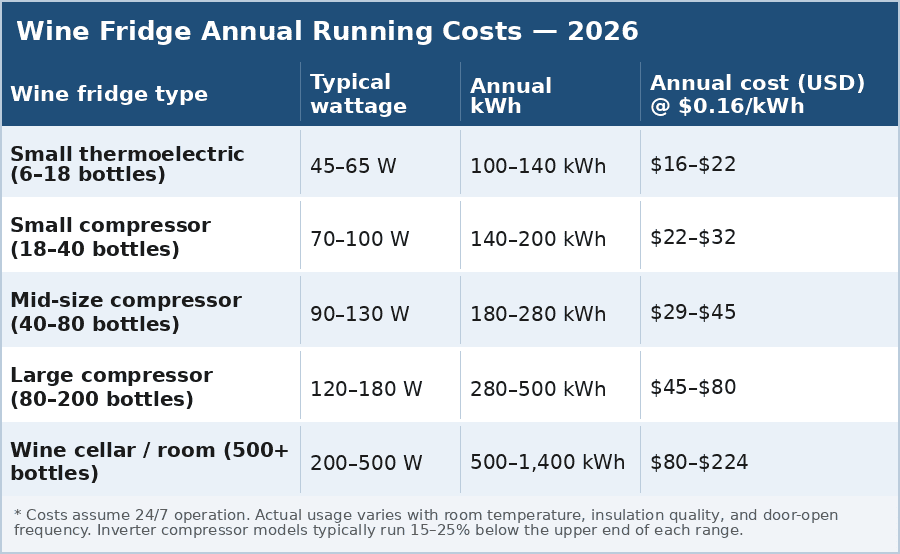
Small wine fridges (6–18 bottles, thermoelectric): these typically draw 45–65 watts and run at roughly 50–60% duty cycle. Expect annual running costs of roughly $30–$45.
Small to mid-size wine fridges (18–40 bottles, compressor): drawing 70–100 watts with typical cycling, annual costs fall in the $40–$65 range.
Mid-size wine fridges (40–80 bottles, compressor, single- or dual-zone): the most popular category for serious home collectors. Expect $55–$95 per year, depending on insulation quality and ambient conditions.
Large wine fridges and wine cabinets (80–200 bottles): $90–$160 per year for well-insulated models, rising to $180–$220 for older or poorly insulated units.
Built-in wine cellars and dedicated room systems vary widely in size and insulation quality. A well-sealed 500-bottle cellar room in a temperate climate can cost $120–$200 annually to run. The same volume in a poorly insulated space in a hot climate can exceed $400.
The most important number to look for when comparing models is the annual kWh consumption figure, which reputable manufacturers publish. Divide that number by 1,000, multiply by your local electricity rate, and you have your true annual cost. In Japan, where Didi Somm is based, electricity rates run roughly ¥25–¥35 per kWh depending on region and provider — so a 200 kWh/year unit costs approximately ¥5,000–¥7,000 annually to run, or around $33–$47 at current exchange rates.
Compressor vs. thermoelectric: the energy efficiency verdict
For small collections in consistently cool rooms (below 72°F / 22°C), a quality thermoelectric unit is quieter, vibration-free, and competitively efficient. For anything larger, for rooms that get warm seasonally, or for serious aging collections where temperature stability is non-negotiable, a modern inverter compressor unit will outperform on both temperature stability and long-term running costs.
The inverter compressor is the key upgrade to look for in 2026. Unlike traditional compressors that switch fully on and off, inverter compressors modulate their speed to match demand — the same technology that transformed home air conditioning efficiency over the past decade. Look for this feature in mid-range and premium units from brands such as EuroCave, Liebherr, and Climadiff.
Five ways to cut your wine fridge running costs without replacing the unit
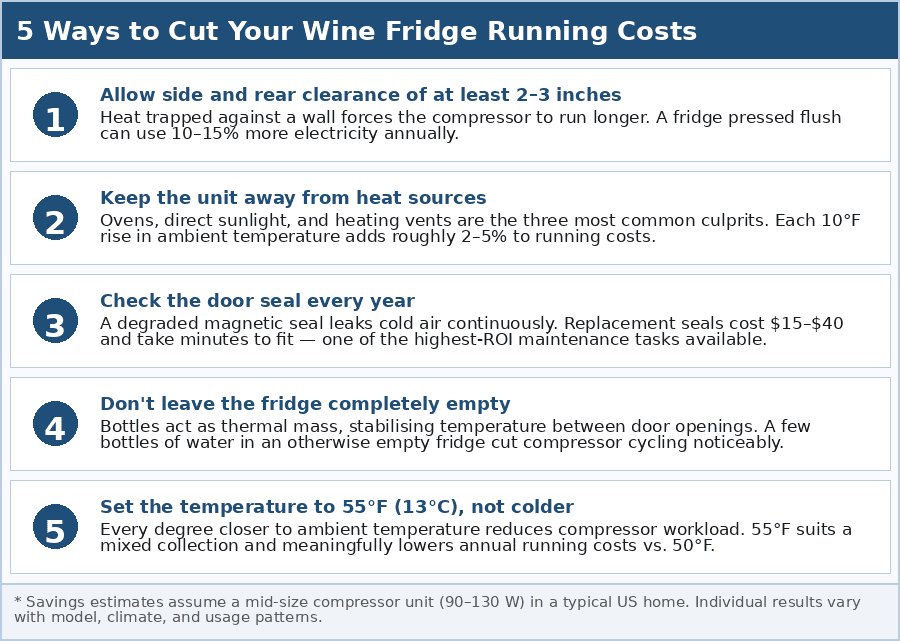
Allow side and rear clearance of at least 2–3 inches so heat can dissipate freely. A fridge pressed against a wall runs its compressor harder and longer.
Keep the unit away from heat sources — ovens, direct sunlight, and heating vents are the three most common culprits that silently inflate running costs.
Check the door seal annually. A degraded magnetic seal leaks cold air continuously. Replacement seals typically cost $15–$40 and take minutes to fit.
Don’t overfill or underfill dramatically. A completely empty wine fridge loses its cool temperature rapidly every time the door opens. A few bottles of water, used as thermal mass, help stabilize the temperature between door openings.
If your fridge has a temperature display, set it to 55°F (13°C) for a mixed collection rather than the coldest setting. Every degree closer to ambient temperature reduces compressor workload.
FAQ – Wine Fridge Energy Cost in 2026
Q: How much electricity does a wine fridge use per year?
Most home wine fridges consume between 100 and 300 kWh per year, depending on size, technology, and placement. At a US average of $0.16/kWh, that works out to roughly $16–$48 annually for efficient models, rising to $90–$160 for larger units.
Are thermoelectric wine fridges more energy efficient than compressor models?
For small collections in cool rooms, yes. In warm rooms or for larger collections, modern inverter compressor units are more efficient overall because thermoelectric systems work harder — and less efficiently — as the ambient temperature rises.
What is an inverter compressor wine fridge?
An inverter compressor modulates its speed to match cooling demand rather than switching fully on and off. This reduces energy consumption, lowers noise, and extends the compressor lifespan — worth seeking out in any mid-range or premium purchase.
Does placement affect wine fridge energy consumption?
Significantly. A fridge in a warm room with poor ventilation, or near a heat source, can use 30–50% more electricity than the same unit in a cool, well-ventilated spot. Placement is the single easiest efficiency improvement available.
How do I calculate the actual running cost of a wine fridge?
Find the annual kWh figure in the manufacturer’s specifications. Multiply by your local electricity rate per kWh. That gives you the annual cost. For example, 150 kWh/year × $0.16 = $24/year.
Do wine fridges use more electricity in summer?
Yes. When ambient temperatures rise, the cooling system works harder to maintain the set temperature. In extreme cases — a garage hitting 100°F in summer — running costs can double compared to winter months.
Is it cheaper to run a wine fridge full or empty?
A moderately full fridge is more efficient. Bottles act as thermal mass, stabilizing temperature and reducing how often the compressor cycles. A completely empty fridge loses its cool temperature rapidly with each door opening.
What temperature should I set my wine fridge to for efficiency?
55°F (13°C) is the classic compromise for a mixed collection and is close enough to ambient room temperature in many climates to reduce compressor workload. Setting it colder than necessary increases running costs without meaningfully benefiting most wines.
How does a wine fridge compare to a regular refrigerator in energy use?
A wine fridge typically uses less electricity than a full-size kitchen refrigerator because it operates at a warmer target temperature (55°F vs. 37°F) and is opened far less frequently. A standard fridge uses roughly 400–600 kWh/year; a wine fridge uses 100–300 kWh/year.
What is the most energy-efficient wine fridge brand in 2026?
Should I unplug my wine fridge when I go on holiday?
No. The temperature swings caused by unplugging and restarting are more harmful to your wine than the small electricity cost of keeping it running. Leave it on.
How long do wine fridges last, and does efficiency degrade over time?
Quality compressor units typically last 10–15 years. Efficiency does gradually decline as compressor components wear, door seals degrade, and dust builds up on condenser coils. Annual cleaning of the condenser coils maintains efficiency throughout the unit’s life.
Conclusion – What to look for when buying for efficiency in 2026
When comparing models, prioritize the published annual kWh figure over the wattage rating — wattage tells you peak draw, not real-world consumption. Look for dual-pane glass doors as standard on any unit with more than 40 bottles. Check for an Energy Star rating or equivalent if you’re buying in the US market. And factor in placement before you buy — the most efficient unit in the wrong spot will underperform a mid-range unit in an optimal location.
Wishing you lots of fun with your new wine fridge, and cheers!
Didi Somm & Team
For your reference, the latest articles by Didi Somm include:
- Wine Aging Potential – Best Expert Guide
- Wine Storage Evolution: Get The Latest Trends Here
- Short Term Wine Storage: All You Need To Know
- Wine Storage Cabinet Guide: What You Need To Know
- Wine Storage Cabinet vs Wine Fridge: Which Is Right For You?
- Best Wine Cabinets For Small Spaces: Top 7 Picks For 2026
Important Notice: The information in this article is for general and public information purposes only. It reflects the opinion of Didi Somm or his staff solely, and no responsibility can be assumed for errors or omissions in the service’s content. For details, please check the Disclaimer at the bottom of the homepage.