
Long before enjoying wine, as a child, I was fascinated by wine bottles, their shapes and colors. Later, when I started getting into wine, I discovered that the world of wine packaging goes well beyond the typical 750ml bottle most of us are used to, but starts with tiny single-serving bottles and ends with the massive Nebuchadnezzars holding the equivalent of 20 standard bottles.
This guide about wine bottle sizes helps you understand the differences in wine bottle shapes and sizes and explore the significance of these variations in serving wine. Additionally, you will gain an appreciation for how the vessel can impact the wine-drinking experience.
Welcome to Didi Somm, and Cheers!
Important Notice: The information in this article is for general and public information purposes only. It solely reflects Didi Somm’s or his Staff’s opinion, and no responsibility can be assumed for errors or omissions in the service’s contents. For details, please check the Disclaimer at the bottom of the homepage.

Main Takeaways
Wine bottles come in a wide range of sizes, from 187.5ml splits to 15L Nebuchadnezzars
Standard wine bottles are 750ml, holding about five glasses of wine
Champagne bottles have specific dimensions and are often compared to standard wine bottles
Larger format bottles age wine more slowly and are great for big celebrations
Half bottles and splits are perfect for solo drinking or trying a premium wine
Alternate bottle shapes like the Burgundy, Alsace, and Bocksbeutel have deep historical and regional roots
Standard Wine Bottle Sizes
The 750ml bottle
It is the most common format, also known as a “fifth,” referring to one-fifth of a gallon. It is the standard wine bottle size in shops, restaurants, and bars.
A 750ml bottle holds about five glasses of wine (5 oz pours) and is perfect for sharing by 2-4 people. Its dimensions typically include a height of around 11.5 inches and a diameter of about 3 inches, which are important to consider when planning wine storage.
The 1.5L Magnum
The next step up from 750ml is the 1.5L magnum, which holds the equivalent of two standard bottles. While not as common, magnums make a significant impact at dinner parties and are my go-to for impressing guests. Many premium wines are also released in magnum as the larger volume ages more slowly and consistently.
The modern wine bottle, with its cylindrical shape, small openings, oxygen-limiting corks, longer necks, gentle ‘shoulders,’ and tapered body, has evolved since the 1820s to become the standard for preserving and shipping wine efficiently.

Large Format Bottles
Large-format wine bottles are the ultimate gesture of generosity and celebration for truly special occasions. They are also popular for sparkling wines.
3L Double Magnum (4 standard bottles)
6L Methuselah (8 bottles)
9L Salmanazar (12 bottles)
12L Balthazar (16 bottles)
15L Nebuchadnezzar (20 bottles)
Opening one of these giants is an unforgettable experience – I’ll never forget sabering a 6L Methuselah champagne bottle at my best friend’s wedding!
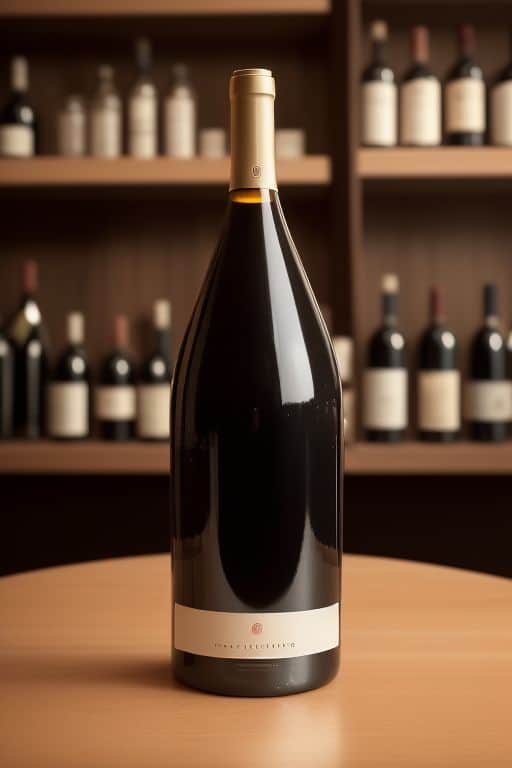
Be aware that these big boys are heavy and unwieldy and may require special equipment to pour and serve properly.
They also need significant time to age – a Bordeaux that might be ready to drink from 750ml after 8-10 years could take 20+ years to mature in a Nebuchadnezzar.
Half Size Bottle and Splits
On the other end of the spectrum are the half-size bottle (375ml or 2.5 glasses) and even smaller 187.5ml “splits” (1.25 glasses). A quarter bottle, also known as piccolo, pony, snipe, or split, is typically used for a single serving of Champagne.
They’re great for tasting menus and wine flights, where you sample multiple wines over a meal. Plus, the smaller volume means less wine is opened to worry about going bad.
Alternative Bottle Shapes
Apart from size, some wines come in unique bottle shapes. Burgundy and Rhône wines are often sold in elegant, sloping-shoulder bottles, while German and Alsace wines favor tall, slender flutes. The squat, flat Bocksbeutel is a symbol of Franconia, while the bulb-shaped Chianti bottle with its straw basket called “fiasco” is an Italian icon. Proper wine racks are essential for holding these varying bottle shapes securely.
These distinctive shapes are steeped in tradition, helping distinguish regional wine styles and adding a touch of Old World charm. At times, they even served practical purposes, like with Chianti bottles, which were made flat on the bottom so they could be easily stacked and transported by cart.
Special wine-racking solutions are necessary to accommodate all non-standard shapes, which range from Champagne to Magnum bottles to Nebuchadnezzars.
International Naming Conventions
One thing to watch out for is that wine bottle sizes go by different names in different countries. An American “fifth” is a European “70cl,” while in Australia, a Methuselah is called a Rehoboam. The same size also sometimes goes by multiple biblical names – a Salmanazar is technically a 12-bottle equivalent but is used interchangeably with 9-bottle Methuselahs. Here’s a quick reference table for the most common international terms:
| Volume | USA/Canada | Europe | Australia |
| 187.5ml | Split/Piccolo | – | – |
| 375ml | Half-bottle/Demi | – | – |
| 750ml | Fifth | 75cl/70cl | Bottle |
| 1.5L | Magnum | Magnum | Magnum |
| 3L | Double Magnum/Jeroboam | Jeroboam/Double Magnum | Double Magnum |
| 4.5L | – | Rehoboam | Jeroboam |
| 6L | Imperial/Methuselah | Imperial/Methuselah | Rehoboam/Imperial |
| 9L | Salmanazar | Salmanazar | Salmanazar |
| 12L | Balthazar | Balthazar | Balthazar |
| 15L | Nebuchadnezzar | Nebuchadnezzar | Nebuchadnezzar |
Pro Tip: Please also check the Wine & Spirit Education Trust’s website
Caveats and Considerations
While it’s fun to explore the wide world of wine bottle sizes, there are a few things to keep in mind:
Cost
Larger format bottles are significantly more expensive than their 750ml counterparts due to higher production costs and lower demand. A magnum often costs 2 to 3 times more than a standard bottle of the same wine.
Storage
Big bottles occupy a lot of space in your cellar or wine fridge. If you’re looking to collect large formats, make sure you have adequate storage.
Drinking Window
The increased volume slows down the aging process, so large-format wines take longer to reach maturity. This is great for preserving age-worthy wines but not ideal for drinking them young.
Serving Challenges
Larger bottles can be difficult to pour and serve. You may need to decant them into smaller vessels or use a wine cradle to pour steadily. Very big bottles like Nebuchadnezzars require multiple people to handle and serve!

FAQ – About Wine Bottle Sizes
1. How many glasses of wine are in a 750ml bottle?
A standard 750ml bottle contains approximately five servings of wine (5 oz pours).
2. What is a magnum of wine?
A magnum is a 1.5L bottle, equivalent to two standard 750ml bottles.
3. How big is a Jeroboam?
A Jeroboam holds 3L or four standard bottles of wine.
4. What are the different wine bottle sizes?
The main sizes are:
– 187.5ml: Split/Piccolo
– 375ml: Half-bottle/Demi
– 750ml: Standard
– 1.5L: Magnum
– 3L: Double Magnum/Jeroboam
– 4.5L: Rehoboam (sparkling wine)
– 6L: Imperial/Methuselah
– 9L: Salmanazar
– 12L: Balthazar
– 15L: Nebuchadnezzar
5. Is a 1.5 L Magnum always called a Magnum?
Yes, a 1.5L bottle is always referred to as a Magnum across all wine regions.
6. Why are large format bottles named after biblical figures?
The naming convention dates back to the early 19th century when Champagne producers started using biblical kings to denote their largest bottle sizes.
7. How much does a full magnum of wine weigh?
A full 1.5L magnum typically weighs around 4.5 lbs or 2 kg.
8. What are the benefits of large-format bottles?
Magnums and bigger bottles age wine more slowly and gracefully. They also make a big impression when served!
9. Are there wine bottles bigger than a Nebuchadnezzar?
Yes, but they are extremely rare. Larger sizes include:
– 18L: Solomon or Melchior
– 27L: Sovereign
– 30L: Melchizedek or Midas
10. What are the drawbacks of large format bottles?
They are expensive, require lots of storage space, and take a long time to reach maturity. Special equipment may be needed to serve them.
11. How long does an open bottle of wine last?
An open 750ml bottle will last 3-5 days in the fridge with the cork reinserted. Thanks to their increased volume, larger bottles will last a little longer.
12. How many ounces are in a 750ml wine bottle?
A standard 750mL bottle contains 25.4 ounces.
13. What are split bottles used for?
Splits are great for solo drinking, by-the-glass pours at bars and restaurants, and serving wine flights or pairings. They’re also perfect for picnics!
14. Can you buy a single serving of wine?
Yes, 187.5ml single-serving bottles or cans are widely available, often on planes, in hotels, and at events.
15. What is the most expensive wine bottle size?
The 30L Melchizedek or Midas holds the equivalent of 40 standard bottles, making it the largest and most expensive wine bottle size. Very few are ever produced.
Conclusion
Wine bottle sizes go well beyond the standard 750ml fifth we’re all familiar with. From single-serving splits to gargantuan Nebuchadnezzars, there’s a wine bottle for every occasion, group size, and budget. While large format bottles are show-stopping centerpieces that make age-worthy wines even more collectible, petite half bottles and splits are perfect for solo drinking or tasting pricier wines.
Knowing the range of sizes and shapes improves your wine knowledge and helps you pick the perfect bottle for any occasion.
When stocking up for a dinner party next time or just looking to treat yourself, consider branching out from the standard 750ml. Cheers!
For your reference, the latest articles by Didi Somm include:
- What Temperature Should Red Wine Be Stored At? – 7 Expert Tips
- Non Alcoholic Wine – 5 “Great Myths” You Must Know
- How to Use a Wine Opener? – 7 Best Tips You Must Know
- Best Red Wine For Cooking – All You Need To Know
- How Much Does a Bottle of Wine Weigh? – Find Out Here
- What Does Wine Taste Like? – Find Out Here
Important Notice: The information in this article is for general and public information purposes only. It solely reflects Didi Somm’s or his Staff’s opinion, and no responsibility can be assumed for errors or omissions in the Service’s contents – for details, please check the Disclaimer at the bottom of the homepage.


